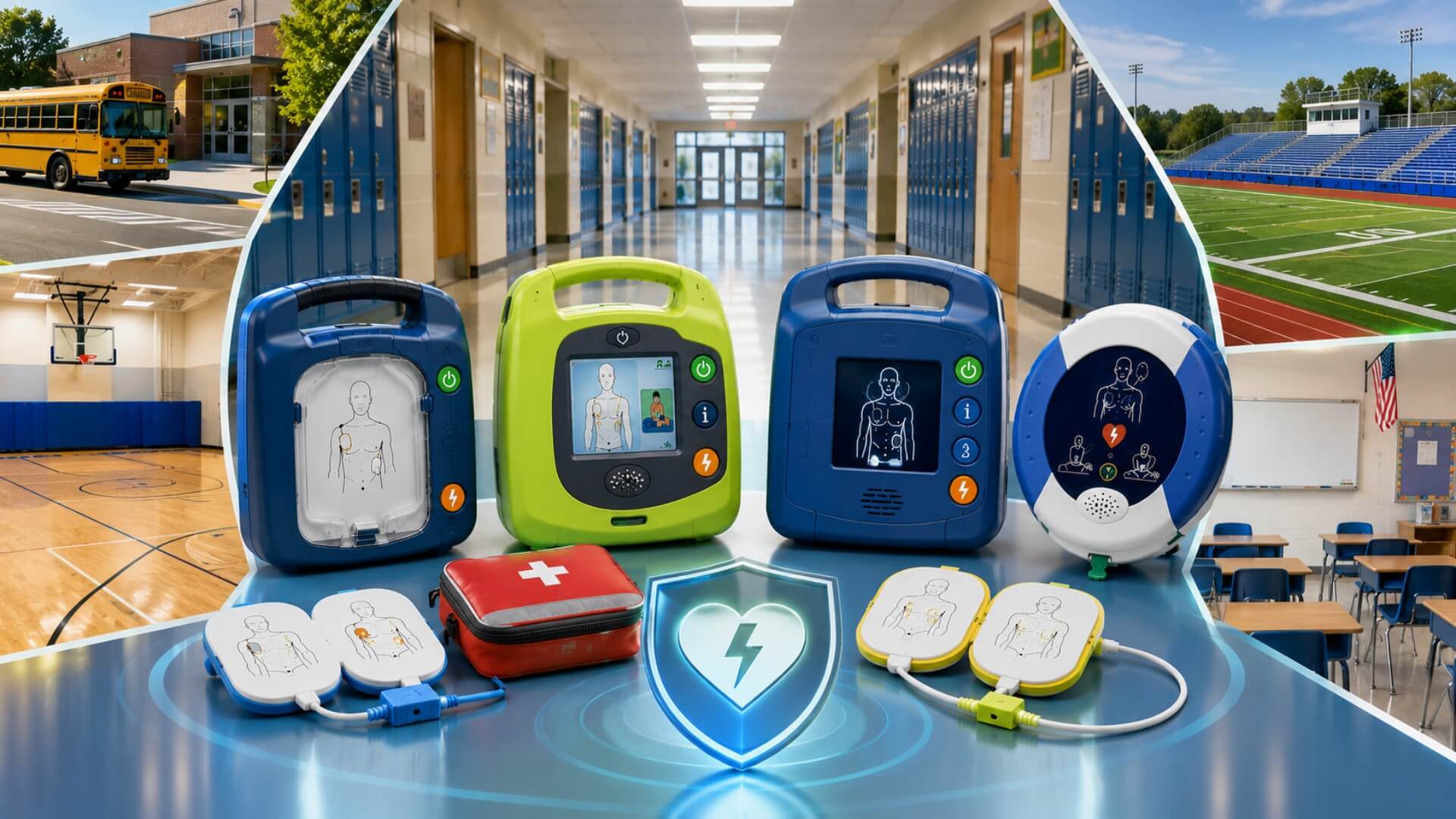
Forty-three U.S. states mandate AEDs in K-12 schools as of 2026, and the highest-risk events in a school setting happen on athletic fields, where SCA is up to 17× more likely during vigorous exertion in habitually inactive individuals (NEJM 2000, Albert CM et al.). The school AED decision has three locked variables: pediatric capability is non-negotiable, the device must survive hallway-transport durability, and per-floor coverage is required.
The AHA 3-minute drop-to-shock standard combined with typical K-12 facility layouts means most schools need at least 2–4 AEDs per main building, not the single unit many districts default to during procurement.
Quick answer
For most K-12 schools, the Philips HeartStart FRx with Infant/Child Key is the standard pick, pediatric workflow is the simplest in the industry, the device is rugged enough for athletic deployment (IP55, 1.22m drop), and the 8-year warranty matches school capital depreciation cycles. Budget-constrained districts: the HeartSine 350P with Pediatric Pad-Pak at $1,411 retail is the cheapest FDA-approved option that meets school requirements.
State law context – do you legally need one?
43+ states mandate AED placement in K-12 schools. Mandate scope varies: some states require a single AED on campus, others require per-building or per-athletic-event coverage. Many states also require a designated trained responder plan and EMS registration.
States with the broadest school AED mandates: California, New York, Florida, Texas, Pennsylvania, Illinois, Massachusetts, Nevada, Maryland, and New Jersey. Verify your state’s specific statute and registration requirements via the AED Laws by State guide before procurement.
How many AEDs does your school actually need
The AHA standard requires defibrillation within 3 minutes of collapse. For K-12 facilities, this translates to roughly one AED per 20,000 sq ft of indoor coverage (slightly tighter than offices to account for multi-wing layouts), plus one per occupied floor, plus one per detached athletic building.
| School profile | Recommended AED count | Placement |
|---|---|---|
| 30,000 sq ft elementary, 1 floor | 2 AEDs | Main office + gym |
| 60,000 sq ft middle school, 2 floors | 4 AEDs | Per floor + gym + cafeteria |
| 120,000 sq ft high school, 3 floors + athletic field | 7 AEDs | Per floor + gym + cafeteria + field house + visitor side |
| 200-acre district with 3 schools | 15+ AEDs | Per building + central PE + transportation |
Run the AED Quantity Calculator with your specific building footprint for an AHA-aligned count.
The 3 picks for K-12 schools
| Model | Price (2026) | Pediatric | Warranty | 5-yr total | Best for |
|---|---|---|---|---|---|
| Philips FRx | $2,099 | Infant/Child Key | 8 yrs | $2,200–$2,800 | Standard pick, mixed adult + pediatric, athletic fields |
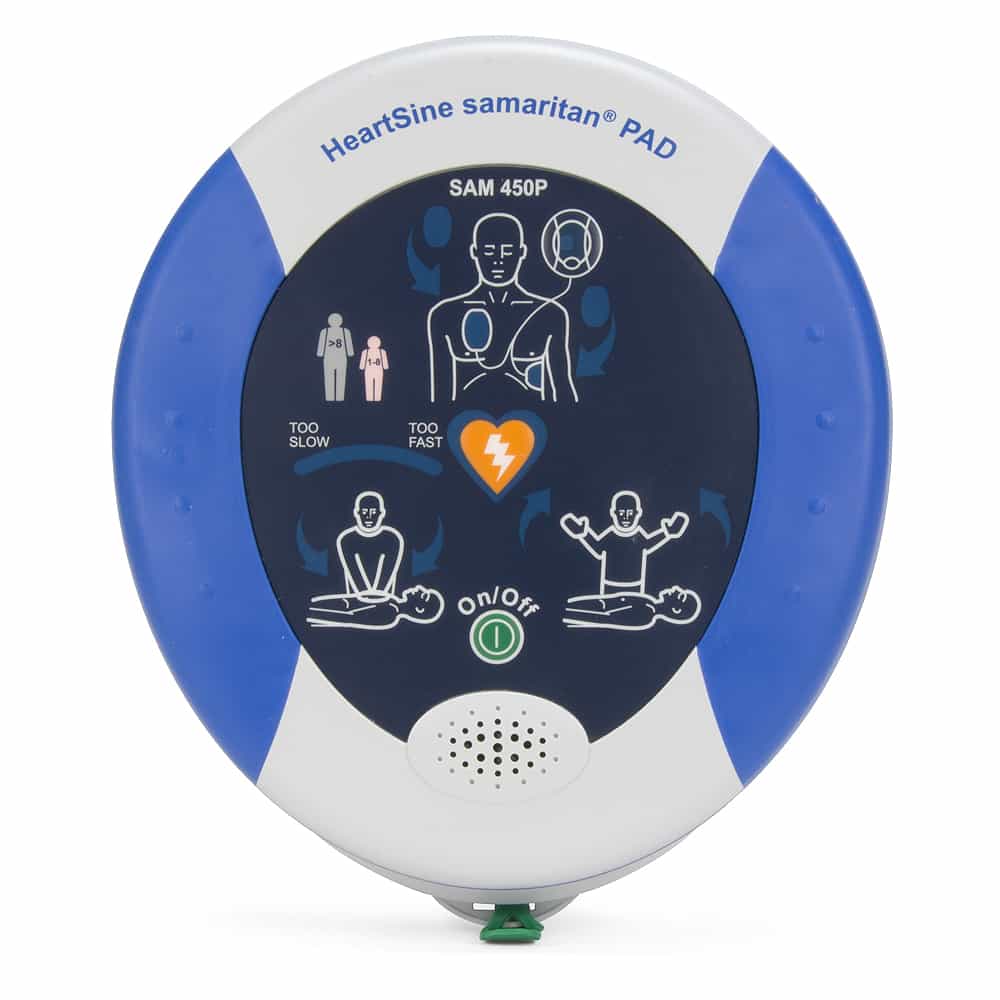
| HeartSine 350P | $1,411 | Pediatric Pad-Pak | 10 yrs | $1,215–$1,500 | Budget pick, small districts, lowest 5-year cost |
| ZOLL AED 3 | $2,199 | Universal Uni-padz | 8 yrs | $2,400–$2,800 | Athletic departments + CPR coaching on muscular athletes |
Why pediatric capability is non-negotiable
Children under 8 years or under 55 lbs require lower-energy defibrillation per American Red Cross and American Academy of Pediatrics guidance. K-12 schools serve patients across the full pediatric weight range, kindergarteners through high-school athletes.
The FRx’s Infant/Child Key reduces shock energy automatically when inserted. No separate pad cartridge to track. No swap workflow during rescue. Under stress, key workflows fail at lower rates than swap workflows, the simplicity is operationally meaningful in a school environment where the rescuer may be a teacher with one-hour-old CPR training.
The athletic field scenario most districts miss
Sudden cardiac arrest during youth athletic events is the highest-risk scenario in a K-12 setting. SCA risk during vigorous exertion is up to 17× higher in habitually inactive individuals (NEJM 2000, Albert CM et al.), and student athletes occupy a population segment where undiagnosed cardiac conditions surface during exertion.
The implication: athletic fields need their own dedicated AED, not a shared unit from the main building. A 4-minute walk from the gym to the football field eats the entire AHA survival window. Districts that share AEDs between buildings and fields are non-compliant with the standard their state law cites.
Verdict by school profile
Standard K-12 · Mixed Adult + Pediatric · Athletic Fields
Philips HeartStart FRx with Infant/Child Key
Industry-standard pick. Pediatric workflow is the cleanest in the market. Rugged enough for hallway and field deployment. 8-year warranty matches school depreciation cycles. Read full FRx review →
Budget-Constrained Districts · Small Schools · Single-AED Buildings
HeartSine 350P with Pediatric Pad-Pak
Cheapest FDA-approved AED meeting K-12 requirements. ~$1,265 5-year total. 10-year warranty. Trade-off: separate Pediatric Pad-Pak required (swap workflow during pediatric rescue).
Frequently asked questions
Are AEDs required in K-12 schools?
Yes in 43+ states. Specific mandates vary, some require per-building, others per-athletic-event, others statewide single-AED. Verify your state’s statute via the AED Laws by State guide.
Which is the best AED for elementary schools specifically?
The Philips HeartStart FRx. Pediatric Infant/Child Key is the simplest workflow for staff handling small-body rescues under stress.
How many AEDs does a high school need?
Typically 4–7, depending on square footage, number of floors, and presence of detached athletic facilities. Use the Quantity Calculator for your specific building.
Are there grants to fund school AEDs?
Yes. The federal AED Access for Heart Health Act funds school AED programs. Most states run additional grants for K-12. Contact your state health department or local AHA chapter.
Do schools need to register their AEDs with EMS?
Many states require EMS registration. Texas, Maryland, Florida, New Jersey, Nevada, and others mandate registration with the local EMS authority. Check your state’s specific requirements.
What training is required for school staff?
Most states require at least 2 designated AED responders per campus with current CPR + AED certification (AHA Heartsaver or equivalent). Renewal cycle is 2 years.
Run the math for your specific facility
Get the 60-second AED recommendation matched to your environment, training level, and budget. Free, no email required.
Sources
- American Heart Association, CPR + AED guidance
- NEJM 2000, Albert CM et al., vigorous exertion + SCA
- American Red Cross, Pediatric AED guidance
- AED Access for Heart Health Act, federal grant documentation
Educational guidance. State laws change. Verify current requirements with your state health department before procurement.