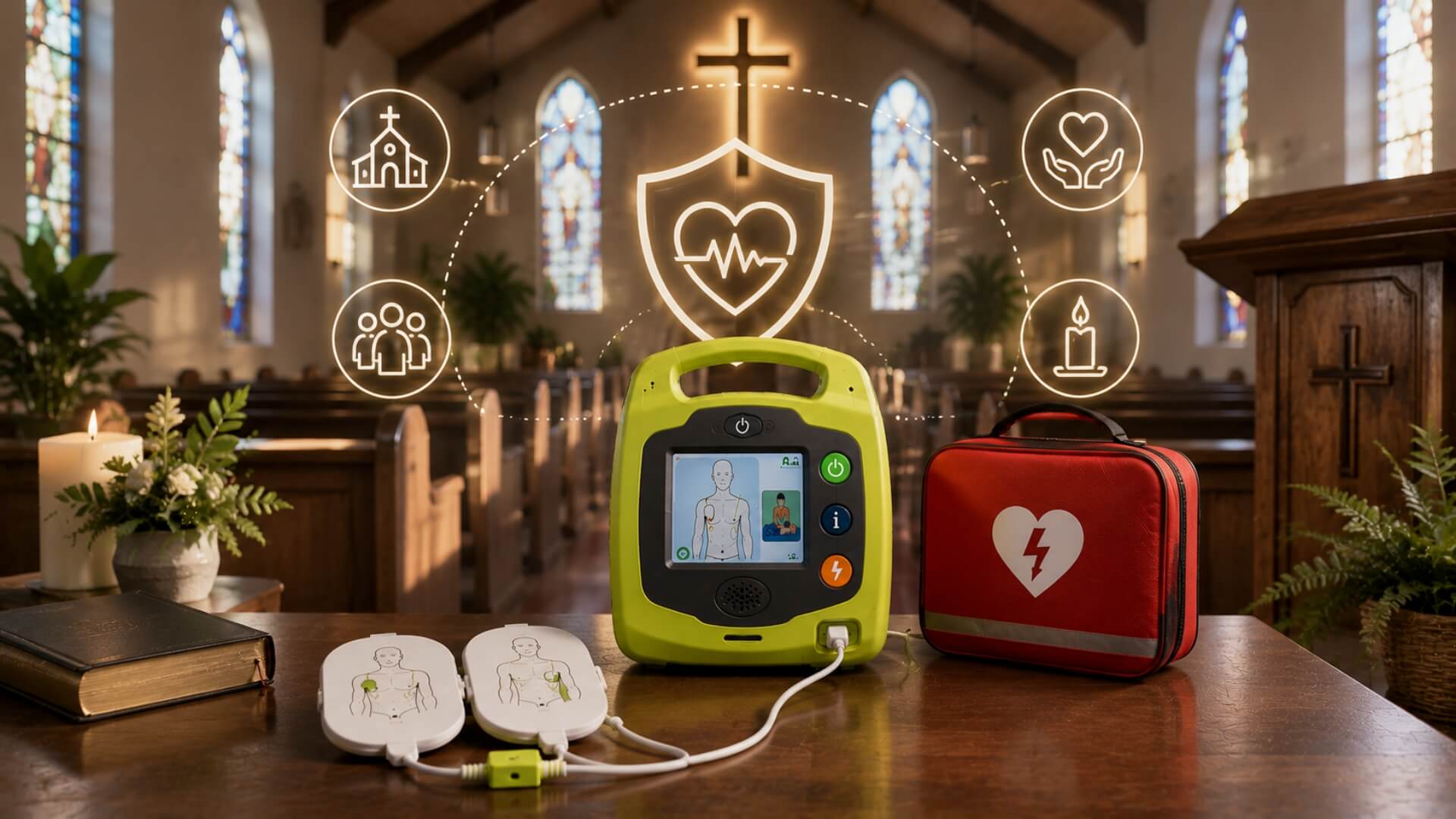
Houses of worship sit at the intersection of two operational realities: an older congregant population statistically more likely to experience a cardiac event, and a volunteer-driven facility model with few trained on-site responders during most service hours. Sudden cardiac arrest in a sanctuary during Sunday service is one of the more common civilian cardiac events documented in EMS post-event data, precisely because the demographic profile of regular attendees skews older.
The church AED program needs two things most operational guides ignore: a device that can be trusted to work when nobody has checked it for 30 days, and a pediatric pathway for the children’s program area that is separate from the sanctuary AED.
Quick answerCardiac Science Powerheart G5 is the standard church pick, Rescue Ready® daily self-test removes the “is the AED working?” question between volunteer checks, fully-automatic shock removes button hesitation, and built-in pediatric mode covers the children’s program. HeartSine 350P is the budget pick for small congregations under 200 members.
Why the volunteer-staffed model changes the device requirement
Commercial facilities have dedicated AED program managers responsible for monthly inspection. Churches typically do not. The AED on the sanctuary wall may go 60+ days between any human verification of its operational status. The single highest failure mode for church AED programs is the device that was assumed to be working but had a depleted battery or expired pads at the moment of need.
Cardiac Science’s Rescue Ready® daily self-test runs a complete check every 24 hours and flashes a visible red indicator if anything fails. For volunteer-managed programs, this automated layer is operationally meaningful.
Coverage planning for houses of worship
Sanctuary + fellowship hall + children’s wing = three distinct zones with potentially different occupancy patterns. A single AED at the entrance is rarely sufficient for facilities over 5,000 sq ft. Add one balcony unit for sanctuaries seating over 500.
| Church profile | AED count | Placement |
|---|---|---|
| Small church, 200 members, single sanctuary | 1 AED | Narthex (entrance) |
| Mid-size church, 500 members, sanctuary + fellowship hall | 2 AEDs | Narthex + fellowship hall |
| Large church, 1,000+ members, sanctuary + children’s wing + balcony | 3–4 AEDs | Narthex + children’s wing + balcony + fellowship hall |
| Megachurch campus, multiple buildings | 5+ AEDs | Per building + central campus + parking-adjacent |
The 3 picks for houses of worship
| Model | Price (2026) | Self-test | Pediatric | Best for |
|---|---|---|---|---|
| Cardiac Science G5 | $1,799 | Rescue Ready® daily | Built-in mode | Standard pick for volunteer-staffed programs |
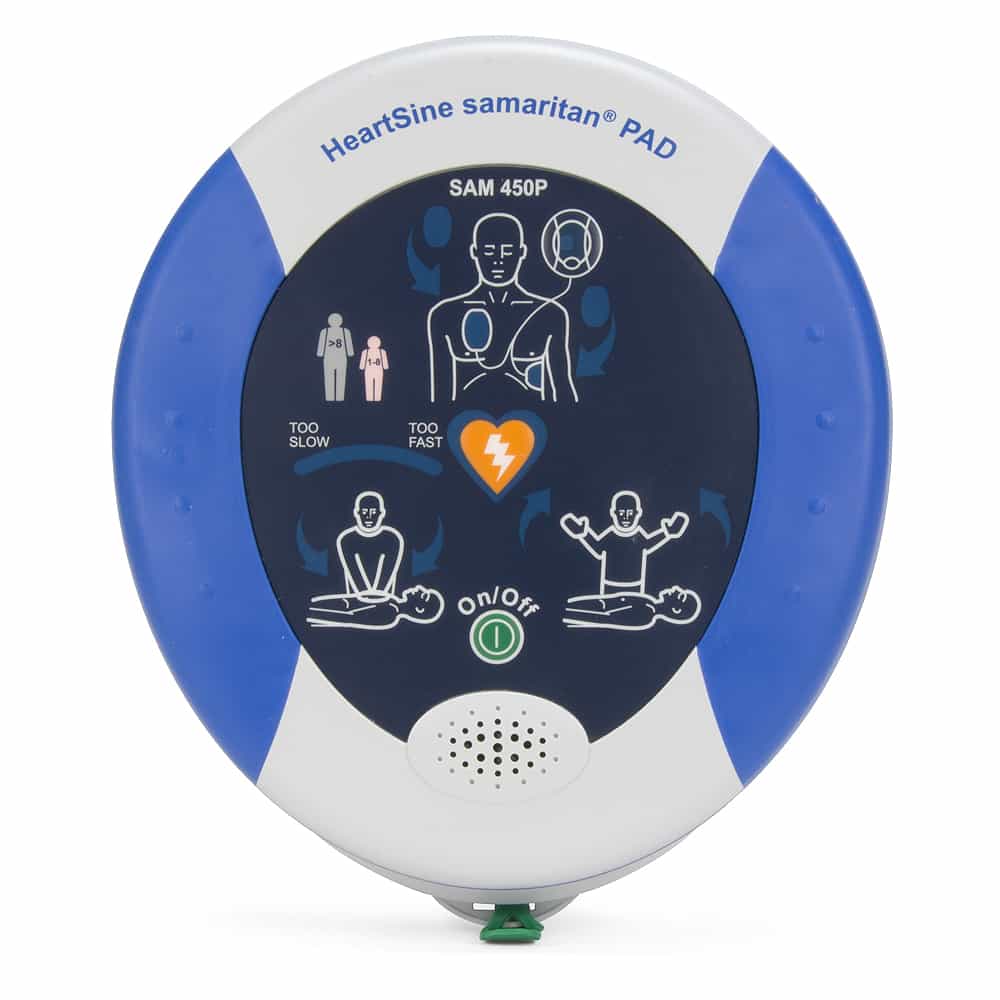
| HeartSine 350P | $1,411 | Periodic | Pediatric Pad-Pak | Budget pick, small congregations |
| Defibtech Lifeline View | $2,024.95 | Periodic | Separate pediatric pads | Multilingual congregations (video screen) |
Children’s program area – pediatric AED is separate
For churches with active children’s programs (Sunday school, daycare, youth ministry), pediatric capability is required. The sanctuary AED’s adult-mode device cannot serve the children’s wing without a workflow change during rescue. Best practice: dedicated pediatric-capable AED in the children’s wing.
The Cardiac Science G5’s built-in child mode button (one press, automatic energy reduction) is the cleanest pediatric workflow at this price point and matches the volunteer-staff operational reality.
Real-world deployment scenario
Mid-size suburban Methodist church, ~600 members, 12,000 sq ft sanctuary + fellowship hall, active children’s wing on second floor, 1 trained responder (the pastor’s wife is a nurse). Recommendation: 1 × Cardiac Science G5 in narthex (sanctuary), 1 × HeartSine 350P in fellowship hall, 1 × Cardiac Science G5 in children’s wing (built-in pediatric mode + Rescue Ready® for low-staff supervision). Total: ~$4,600 device cost + ~$1,100 5-year consumables + ~$450 cabinets = ~$6,150 over 5 years.
Verdict by church profile
Standard House of Worship · Volunteer Staff · Children’s Program
Cardiac Science Powerheart G5
Rescue Ready® daily self-test fits the volunteer operational model. Built-in pediatric mode covers the children’s wing. The fully automatic option removes button hesitation. Read G5 review →
Small Congregation · Single Sanctuary · Budget-Constrained
HeartSine 350P
Cheapest credible option. ~$1,215 5-year program total. 10-year warranty. Trade-off: periodic self-test (not daily) requires more diligent volunteer inspection.
Frequently asked questions
Are churches legally required to have AEDs?
Few states require it directly. Some states’ public-access laws cover houses of worship at certain occupancy levels. Verify your state via the AED Laws by State guide.
Why is self-test so important for churches?
Volunteer-managed facilities lack dedicated AED program managers. The device may go weeks between manual checks. Rescue Ready® daily self-test removes the “is it working?” uncertainty.
Can a small church get an AED grant?
Yes. Several states run AED grants for houses of worship. Local AHA chapters also offer assistance. The Federal AED Access for Heart Health Act focuses on schools, but state-level church programs exist.
How many trained AED responders should a church have?
Minimum 2 designated and CPR + AED certified. Renewal cycle is 2 years (AHA Heartsaver standard).
Should the children’s wing have its own AED?
Yes, if the children’s program area is more than 90 seconds walking distance from the sanctuary AED. Pediatric-capable device required.
Where should the AED be mounted in a sanctuary?
Narthex (entrance) at chest height in an unlocked alarmed cabinet. Avoid mounting in locked offices, sound booths, or any space requiring a key.
Run the math for your specific facility
Get the 60-second AED recommendation matched to your environment, training level, and budget. Free, no email required.
Sources
Educational guidance. Not legal or compliance advice.