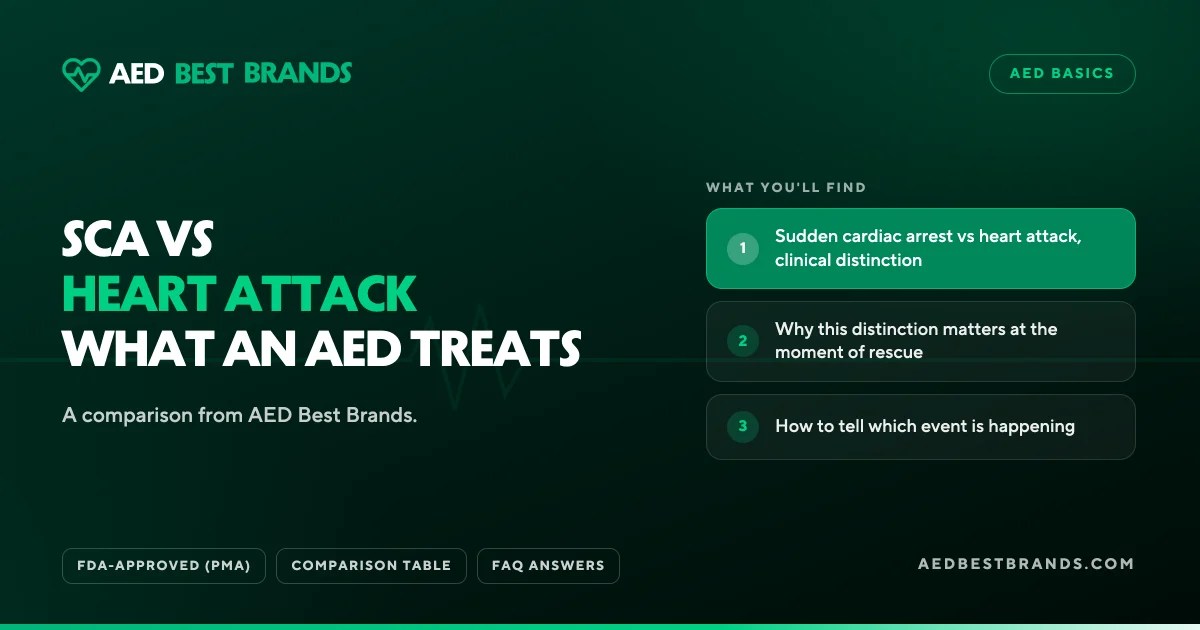
The single most common AED misconception is that AEDs treat heart attacks. They don’t. AEDs treat sudden cardiac arrest, a different clinical event with different causes, different presentations, and different treatments. Conflating the two leads to misuse and to an AED program design that fails the actual rescue scenario.
Sudden cardiac arrest (SCA) is an electrical malfunction of the heart that causes circulation to stop. The patient collapses, loses consciousness, and stops breathing normally. An AED treats SCA by analyzing the rhythm and delivering a shock if defibrillation is indicated. A heart attack (myocardial infarction) is a circulatory problem, a blocked coronary artery starves the heart muscle of blood. The patient is typically conscious with chest pain. An AED does not treat a heart attack. Heart attack treatment requires hospital intervention to restore blood flow.
Sudden cardiac arrest vs heart attack, clinical distinction
| Feature | Sudden Cardiac Arrest (SCA) | Heart Attack (MI) |
|---|---|---|
| Root cause | Electrical malfunction | Blocked coronary artery |
| Patient consciousness | Unconscious | Typically conscious |
| Patient breathing | Stopped or abnormal (gasping) | May be normal or labored |
| Pulse | Absent or ineffective | Usually present |
| Onset speed | Within seconds (collapse) | May develop over minutes to hours |
| Patient pain | The patient may not feel pain (unconscious) | Often, severe chest pain or pressure |
| AED indicated? | Yes, primary treatment | No, does not treat blockage |
| Treatment | CPR + AED + EMS | EMS + hospital catheterization / clot-buster medication |
| Annual US incidence | ~350K out-of-hospital (CDC) | ~805K (AHA) |
Why this distinction matters at the moment of rescue
An adult having a heart attack who is conscious and speaking does not need an AED, they need 911, aspirin, and rapid transport to a cardiac catheterization lab. Attempting to defibrillate a conscious heart attack patient is incorrect treatment.
However, heart attacks can deteriorate into sudden cardiac arrest if the damaged heart muscle triggers ventricular fibrillation. A patient who collapses during a heart attack and loses consciousness has transitioned from MI to SCA. At that moment, the AED is the correct treatment.
How to tell which event is happening
SCA signs: Patient is collapsed, unresponsive, not breathing normally (or only gasping). No pulse.
Heart attack signs: Patient is conscious, complaining of chest pain or pressure, may have shortness of breath, nausea, and sweating. Pain may radiate to the arm, jaw, or back.
If the patient is unconscious and not breathing normally: assume SCA, begin CPR, and apply the AED. The device will determine whether a shock is indicated. If the patient is conscious and complaining of chest pain: call 911, do not apply the AED, give aspirin if available and not contraindicated.
Survival outcomes by intervention timing
SCA survival is highly time-dependent. Defibrillation within 3 minutes drives survival to ~70% (AHA). Past 10 minutes, survival drops below 5%. Heart attack outcomes depend on time to coronary intervention, typically, the “golden 90 minutes” from symptom onset to cath lab procedure determines myocardial salvage.
Frequently asked questions
Can an AED save someone having a heart attack?
Only if the heart attack progresses to sudden cardiac arrest. AEDs do not treat the underlying arterial blockage of a heart attack.
What’s the difference between SCA and heart attack incidence?
~350K SCAs out-of-hospital annually in the US (CDC). ~805K heart attacks annually (AHA). Different events with different epidemiology.
Can a heart attack cause sudden cardiac arrest?
Yes. Heart attacks can trigger SCA when the damaged heart muscle triggers ventricular fibrillation. This is the most common AED-relevant scenario.
What should I do if someone is having a heart attack?
Call 911 immediately. Have the patient sit or lie comfortably. Give aspirin if available and not contraindicated (allergy, bleeding). Do not apply an AED unless the patient becomes unconscious and stops breathing normally.
Why is SCA survival so much lower than heart attack?
SCA is immediately fatal without intervention. The 3-minute defibrillation window vs the 90-minute heart attack treatment window reflects different physiological urgencies.
Does the AED know the difference?
The AED analyzes the heart rhythm. If the rhythm is shockable (ventricular fibrillation, pulseless VT), it advises shock. If the rhythm is normal or non-shockable, it advises no shock. The device does not “diagnose” SCA vs MI, it analyzes the electrical signal.
Run the math for your specific facility
Get the 60-second AED recommendation matched to your environment, training level, and budget. Free, no email required.
Sources
- AHA, CPR + AED guidance
- CDC, Sudden cardiac arrest data
- American Heart Association, Heart Disease and Stroke Statistics
Educational content. Not medical advice. In a medical emergency, call 911.