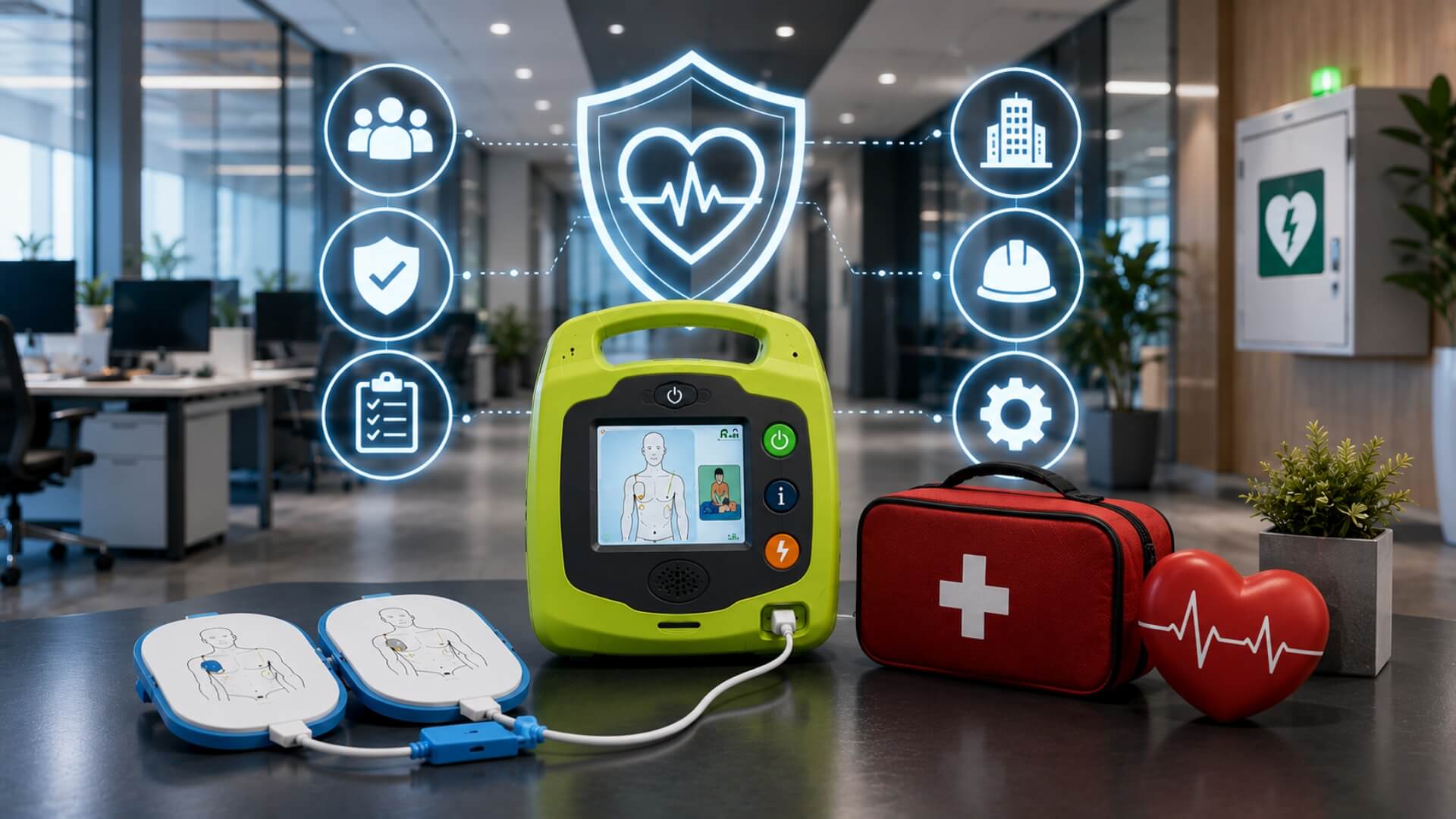
Workplace AED programs are referenced directly in OSHA Publication 3185 as part of standard emergency preparedness under the General Duty Clause, but OSHA does not mandate AEDs in all workplaces. The office buyer’s decision sits between regulatory voluntariness and a population reality: roughly 70% of cardiac arrests happen at home or work (JAMA Cardiology 2022), and the average US EMS response time of 8 minutes drops survival to ~20% without on-site AED access.
For most offices, the pick is between maximum simplicity (untrained staff, single-floor footprint) and feature-rich devices (trained ERTs, multi-floor with fleet management). The $415 spread between the cheapest credible office AED and the high-end pick is operationally meaningful.
Quick answer
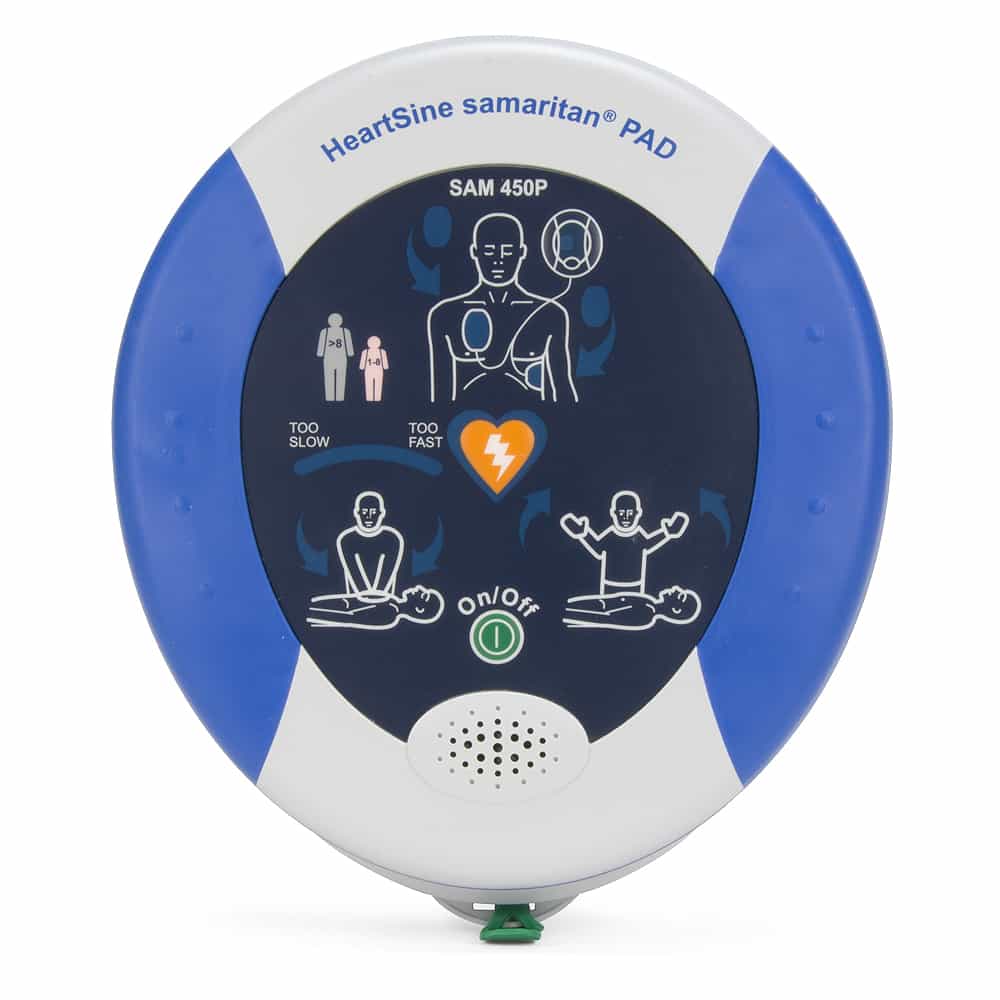
Philips HeartStart OnSite (HS1) is the standard office pick, pull-handle simplicity, calm voice prompts, lowest 5-year cost in the trusted-brand class. HeartSine 350P for budget-constrained small businesses. ZOLL AED Plus or Cardiac Science G5 for trained-team workplaces (50+ staff) where CPR feedback or daily self-test is operationally meaningful.
OSHA, state law, and the office AED compliance reality
OSHA’s General Duty Clause requires employers to provide a workplace free from recognized hazards, and OSHA Publication 3185 explicitly endorses workplace AED programs. State laws vary: Nevada, California, Massachusetts, and New York have the broadest workplace AED mandates. Most other states leave workplace AED placement voluntary.
Voluntary placement is still operationally smart for any workplace over ~50 employees because the EMS response window math is unforgiving: 8-minute average response = ~20% survival, vs ~70% survival if on-site AED is used within 3 minutes (AHA).
How many AEDs does your office actually need
The AHA 3-minute standard applied to office floor plans means roughly one AED per 22,000 sq ft of indoor coverage, plus one per occupied floor, plus one per detached building. Most offices under-buy because they treat the device as a single facility-wide asset rather than a per-floor requirement.
| Office profile | AED count | Placement |
|---|---|---|
| 20-person office, 5,000 sq ft, 1 floor | 1 AED | Near reception |
| 100-person office, 25,000 sq ft, 1 floor | 2 AEDs | Reception + central area |
| 250-person office, 50,000 sq ft, 2 floors | 3 AEDs | Per floor + lobby |
| 500+ staff, 100,000 sq ft, 4 floors | 6+ AEDs | Per floor + per elevator bank |
The 3 picks for offices and workplaces
| Model | Price (2026) | Best for staff size | 5-yr total | Why |
|---|---|---|---|---|
| Philips HeartStart OnSite | $1,589 | 20–100 staff | $1,800–$2,200 | Simplest voice prompts, lightest unit, OTC heritage |
| HeartSine 350P | $1,411 | 1–50 staff | $1,215–$1,500 | Lowest 5-year cost, 10-year warranty |
| ZOLL AED Plus | $2,082 | 100+ trained team | $2,000–$2,400 | Real CPR Help® + 5-year consumables + fleet-grade |
Untrained staff vs trained ERT – the device tier decision
Untrained staff need maximum simplicity. The Philips OnSite’s pull-handle activation and calm voice prompts produce the lowest first-time-correct-use failure rate in field deployment data. The OnSite was originally the first OTC AED in the US, designed from inception for lay-public deployment.
Trained ERTs unlock value from advanced features. The ZOLL AED Plus’s Real CPR Help® coaching is meaningful when the rescuer is following protocol and can act on compression depth feedback. For an untrained office worker, the depth feedback is processed inconsistently under stress, voice prompts and metronome alone produce similar outcomes.
Verdict by office profile
20–100 Staff · Single-Floor · Untrained Staff
Philips HeartStart OnSite (HS1)
Pull-handle simplicity. Calm voice prompts. Lowest 5-year cost in the trusted-brand class. The default pick for most US offices. Read OnSite review →
100+ Staff · Multi-Floor · Designated Responders
ZOLL AED Plus or Cardiac Science Powerheart G5
CPR coaching (ZOLL) or Rescue Ready® daily self-test (G5) becomes operationally meaningful at scale. 5-year consumables math improves fleet economics.
Frequently asked questions
Does OSHA require AEDs in offices?
No, not directly. OSHA Publication 3185 endorses workplace AED programs under the General Duty Clause, but does not mandate placement in most workplaces. Several states (NV, CA, MA, NY) have broader workplace AED mandates.
Should small offices (under 50 staff) have an AED?
It’s voluntary but operationally smart. 70% of cardiac arrests happen at home or work. EMS response averages 8 minutes, long enough that on-site AED access materially changes outcomes.
How many AEDs does a multi-floor office need?
At a minimum of one per occupied floor. Stair and elevator transit eats the 3-minute survival budget. Run the Quantity Calculator for your specific building.
Can businesses deduct AEDs as a tax expense?
Yes. AEDs typically qualify as Section 179 business expenses or capital equipment. Confirm with your tax advisor.
What’s the lowest-cost FDA-approved AED for a small business?
The HeartSine 350P at ~$1,411 retail. Total 5-year program ~$1,215.
Do offices need pediatric AED capability?
Only if children are regularly present (family-facing services, on-site daycare). Most adult-only offices don’t need pediatric mode.
Run the math for your specific facility
Get the 60-second AED recommendation matched to your environment, training level, and budget. Free, no email required.
Sources
Educational guidance. Not legal or compliance advice.