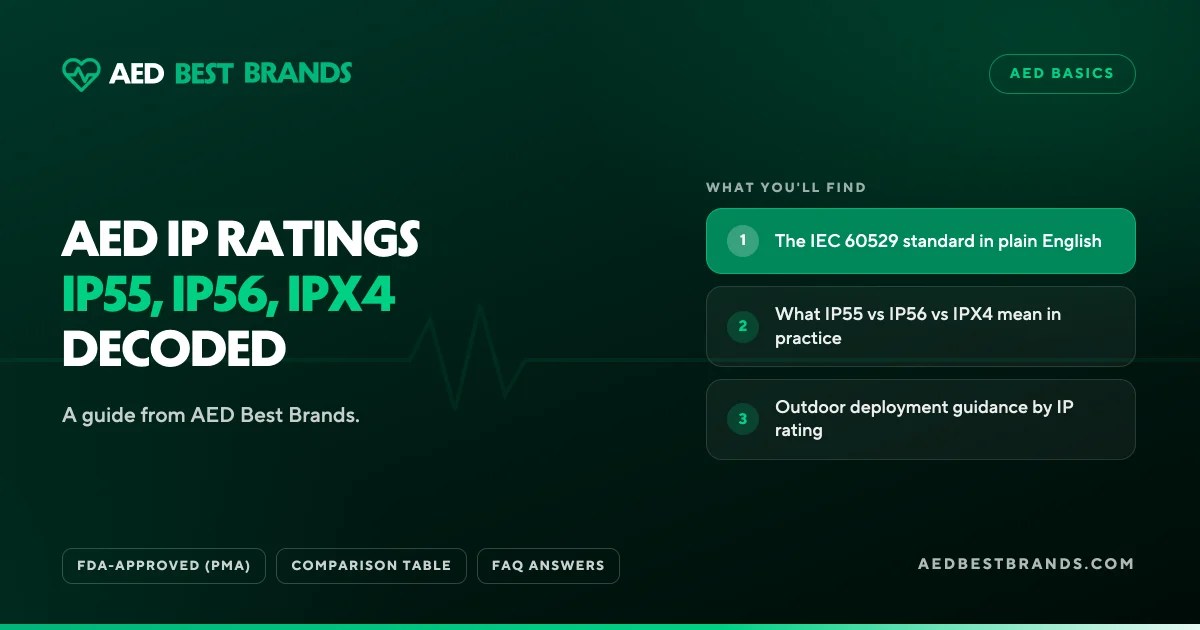
Most AED buyers see “IP55” or “IP56” on a spec sheet and don’t know what either rating actually means. The difference can determine whether the device survives a pool-deck deployment or fails its first humid summer day. IP ratings are an IEC 60529 standard, two digits, each with a specific meaning, defined to engineering precision.
IP ratings have two digits. First digit = dust protection (0-6). Second digit = water protection (0-9). IP55 = dust-protected + jet water from any direction. IP56 = dust-protected + powerful jet water. IPX4 = no dust spec + splash water only. For outdoor sports fields, sustained-weather deployments, or pool decks, IP56 is the gold standard.
The IEC 60529 standard in plain English
| First digit (dust) | Protection |
|---|---|
| 0 | None |
| 1 | Objects >50mm (hand-size) |
| 2 | Objects >12.5mm (finger-size) |
| 3 | Objects >2.5mm (tool-size) |
| 4 | Objects >1mm (wire-size) |
| 5 | Limited dust ingress (dust-protected) |
| 6 | Total dust ingress prevention (dust-tight) |
| Second digit (water) | Protection |
|---|---|
| 0 | None |
| 1 | Vertical drips |
| 2 | Drips at 15° tilt |
| 3 | Spray at 60° from vertical |
| 4 | Splash from any direction |
| 5 | Jet water from any direction |
| 6 | Powerful jet water from any direction |
| 7 | Temporary submersion (1m depth, 30 min) |
| 8 | Continuous submersion (manufacturer-specified) |
What IP55 vs IP56 vs IPX4 mean in practice
IP55 (Philips FRx, ZOLL AED Plus, ZOLL AED 3, Cardiac Science G5, LIFEPAK CR2): Dust-protected, jet water from any direction. Suitable for indoor humid environments, sports fields with cabinet protection, and gym pool decks with cabinet protection.
IP56 (HeartSine 350P, 360P, 450P): Dust-protected, powerful jet water from any direction. Suitable for outdoor sustained weather, construction sites, agricultural, marine adjacent.
IPX4 (Defibtech Lifeline View): No dust protection specification, splash water only. Indoor-only deployment. Not suitable for sports fields or pool decks without significant cabinet protection.
Outdoor deployment guidance by IP rating
| Deployment environment | Minimum IP rating recommended |
|---|---|
| Indoor office, hotel lobby, school hallway | No IP spec required |
| Gym, fitness floor, humid indoor | IP55 minimum |
| Pool deck, locker room (humid) | IP56 recommended |
| Outdoor sports field with a cabinet | IP55 with weatherproof cabinet OR IP56 |
| Outdoor sustained weather (no cabinet) | IP56 minimum + outdoor heated cabinet |
| Construction site, agricultural | IP56 minimum + outdoor heated cabinet |
| Marine, dock, boat | IP56 minimum + saltwater-rated enclosure |
Why outdoor cabinets matter even with high IP ratings
An IP56-rated AED can survive direct rain. But cold-weather exposure can affect battery performance, and prolonged UV exposure can degrade pad adhesive. For sustained outdoor deployment, an outdoor heated cabinet (typically $300–$500) provides temperature control, alarm-on-open notification, and weather protection beyond the device’s own IP rating.
Frequently asked questions
What does IP55 actually mean?
Dust-protected (limited ingress) + jet water from any direction. Suitable for indoor humid environments and outdoor deployment with cabinet protection.
Which AED has the highest IP rating?
HeartSine 350P, 360P, 450P at IP56. The Defibtech Lifeline DDU-100 also offers IP54-equivalent on outdoor variants.
Can I use an IP55 AED outdoors?
With cabinet protection, yes. For sustained outdoor weather without a cabinet, IP56 is recommended.
Is IPX4 enough for a gym?
For low-humidity gym environments, possibly. For pool-adjacent or sauna-adjacent placement, no, IP55 or IP56 is the safer rating.
What’s the difference between IP55 and IP56?
The second digit, IP55 handles jet water, IP56 handles powerful jet water. Practically, IP56 is the higher-end weather rating.
Are AEDs ever IP67 or IP68 rated?
Rare in consumer AEDs. Most operating environments don’t require submersion protection. EMS-grade devices may approach IP67 specs.
Pediatric-first AED procurement
The free quiz routes daycare-profile buyers to the right pediatric-capable model.
Sources
- IEC 60529 standard, IP rating definitions
- Manufacturer specifications, Philips, ZOLL, HeartSine, LIFEPAK, Cardiac Science, Defibtech
Educational content. Manufacturer specs and environmental conditions vary.