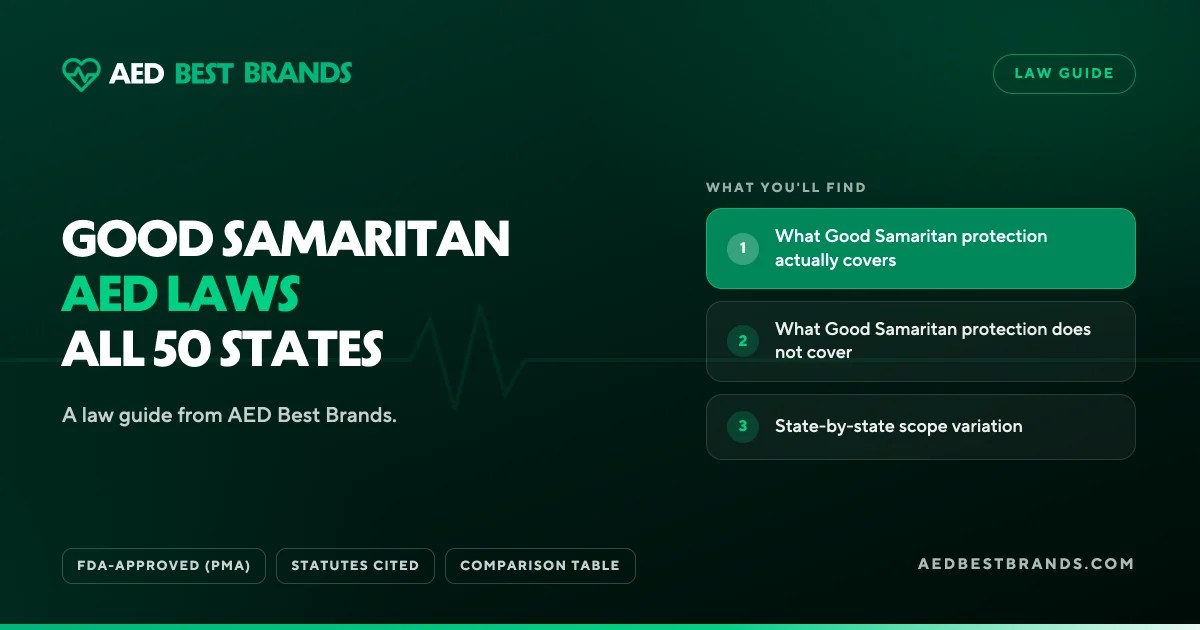
Roughly 70% of bystanders who witness a sudden cardiac arrest do not attempt CPR or AED use, and the most cited reason in survey research is fear of legal liability if something goes wrong. The legal reality is the opposite: all 50 U.S. states have Good Samaritan laws that explicitly protect bystanders who use an AED in good faith.
Quick answer
All 50 U.S. states protect Good Samaritan rescuers who use an AED in good faith without gross negligence or intent to harm. Protection covers the rescuer, AED owners who made the device available, and trainers who provided CPR + AED instruction. The protection does not apply to medical professionals acting in their professional capacity, or to facilities that failed to maintain the AED.
What Good Samaritan protection actually covers
Good Samaritan AED protection typically covers three categories of persons: the lay rescuer who uses the device in good faith; the AED owner who provided the device for public access; and CPR + AED trainers who provided instruction. Protection applies when the rescuer acted without intent to harm and without gross negligence (AHA).
What Good Samaritan protection does not cover
- Medical professionals acting in their professional capacity (a nurse on duty, an EMT on the clock)
- Gross negligence, willful or reckless disregard for patient safety
- Failure to maintain the AED in working condition (the owner’s responsibility separately)
- Compensation seeking, protection generally applies only to volunteer rescue without expectation of payment
- Intentional harm
State-by-state scope variation
| Model | New | Recertified | You save | Buy |
|---|---|---|---|---|
| Philips HeartStart OnSite | $1,589 | $875 | $714, 45% | 1 to 45 or more |
| Philips HeartStart FRx | $2,099 | $875 | $1,224, 58% | 1 to 45 or more |
| ZOLL AED Plus | $2,082 | $875 | $1,207, 58% | 1 to 45 or more |
| ZOLL AED 3 | $2,399 | $1,150 | $1,249, 52% | 1 to 45 or more |
| HeartSine Samaritan PAD 350P | $1,411 | $875 | $536, 38% | 1 to 45 or more |
| HeartSine Samaritan PAD 450P | $1,761 | $875 | $886, 50% | 1 to 45 or more |
| Cardiac Science Powerheart G5 | $2,157 | $1,225 | $932, 43% | 1 to 45 or more |
| Protection scope | Coverage examples |
|---|---|
| Broadest (CA, NY, FL) | Rescuer + AED owner + trainer + facility, covering both civil and criminal exposure |
| Standard (most states) | Rescuer protection in good-faith use; AED owner protection contingent on maintenance |
| Narrowest (a few) | Rescuer-only protection with explicit gross negligence carve-out |
For state-specific statute citations and scope details, see the AED Laws by State guide.
What the AED owner must do to maintain protection
Most state Good Samaritan AED laws condition AED-owner protection on maintenance of the device, typically monthly visual inspection, pad and battery replacement per manufacturer schedule, and registration with local EMS where mandated. Facilities that demonstrably failed to maintain the AED may lose protection.
Frequently asked questions
Will I be sued if I use an AED on someone?
Highly unlikely. All 50 states protect Good Samaritan AED rescuers acting in good faith. Documented lawsuits against lay AED rescuers are exceptionally rare.
Does protection apply if the patient dies?
Yes. Outcome does not affect Good Samaritan protection. Good faith intent and absence of gross negligence are what matter.
What is “gross negligence” in this context?
Reckless disregard for patient safety. Most accidental errors during a panicked rescue do not meet this threshold. Consult a lawyer for specific facts.
Does Good Samaritan protect off-duty medical professionals?
Typically yes, when acting voluntarily without compensation. Acting in a professional capacity at work is generally not covered.
Do facilities need to register their AEDs with EMS?
Many states require it. Texas, Maryland, Florida, New Jersey, Nevada, and others mandate registration. Check your state’s specific requirements.
Can a Good Samaritan be charged criminally?
Extremely rare. The intent threshold for criminal liability requires conduct that grossly exceeds normal rescue behavior.
Run the math for your specific facility
Get the 60-second AED recommendation matched to your environment, training level, and budget. Free, no email required.
Sources
Educational content. Not legal advice. Consult a lawyer familiar with your state’s AED laws for specific situations.