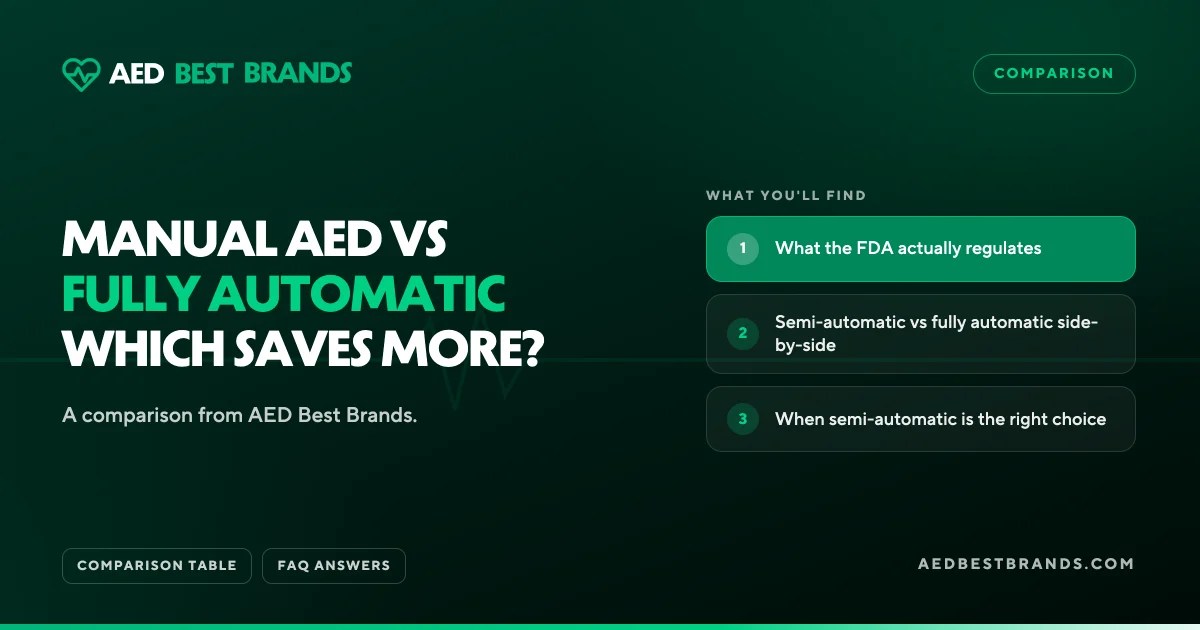
“Manual AED” is a search term most buyers use incorrectly. True manual defibrillators, devices that require the rescuer to interpret heart rhythm and select shock energy, are EMS and hospital tools, not consumer AEDs. The actual buyer decision is between semi-automatic (the rescuer presses a shock button when prompted) and fully automatic (the device delivers the shock without a button press).
This is the single most overlooked AED decision and one of the most consequential. Shock-button hesitation under stress is a documented rescue-failure mode: in lay-bystander rescues observed by EMS agencies, untrained rescuers freeze for an average of 8–15 seconds when prompted to press the shock button, a delay long enough to drop survival probability by 7–14% per occurrence (AHA).
Quick answerBuy a fully automatic AED for facilities staffed by untrained volunteers, high-turnover environments, lay-public access (hotels, retail, places of worship), and any setting where the first responder may be a panicked bystander. Buy a semi-automatic AED for facilities with trained ERTs, healthcare clinics, EMS-adjacent settings, and any environment where the rescuer wants explicit control of shock timing.
What the FDA actually regulates
Both semi-automatic and fully automatic AEDs hold the same FDA premarket approval and are protected under the same all-50-state Good Samaritan laws. The FDA designates AEDs as Class III medical devices, but classifies fully automatic models as suitable for lay use under the same labeling as semi-automatic. As of 2022, the FDA reclassified all AEDs as accessible without a prescription for general public use.
What differs is the rescue workflow at the moment of shock delivery, and the cognitive load required from the rescuer.
Semi-automatic vs fully automatic side-by-side
| Spec | Semi-Automatic AED | Fully Automatic AED |
|---|---|---|
| Shock delivery | Rescuer presses shock button when prompted | Device delivers shock automatically after countdown |
| Cognitive load on rescuer | Higher (must press button under stress) | Lower (passive standby) |
| Recommended training level | Untrained-OK · trained preferred | Untrained-OK · ideal for untrained |
| Rescuer hesitation risk | 8–15 sec average delay in untrained users | Eliminated by design |
| Trained-responder control | Yes (timing flexibility) | No (device-controlled) |
| Typical price premium | Baseline | $0–$300 over semi-auto |
| FDA classification | Class III | Class III |
| Good Samaritan protected | All 50 states | All 50 states |
Why fully automatic materially improves untrained-rescuer outcomes
The shock button is the single moment where an untrained rescuer’s cognition becomes critical. The AED has already analyzed the rhythm, decided a shock is needed, and prompted the rescuer to act. A trained responder presses the button immediately. An untrained bystander hesitates, interpreting the prompt, fearing harm, looking for confirmation.
That 8–15 second hesitation is observable across multiple EMS post-event review datasets. For a patient already 4 minutes into cardiac arrest, an additional 12-second delay drops survival probability from approximately 50% to approximately 42% (AHA decay rate of 7–10% per minute).
Fully automatic AEDs eliminate this moment. The device performs a 3-second audible countdown (“Stand clear. Shock in 3, 2, 1.”) and delivers the shock without requiring rescuer action. The rescuer’s job becomes positional (clear of the patient) rather than decisional (press now, or not).
When semi-automatic is the right choice
Trained ERTs in healthcare, security, and corporate first-aid programs typically prefer semi-automatic AEDs. Reasons: explicit control of shock timing relative to compression rhythm, training continuity with EMS-grade devices (which are manual/professional units), and the ability to override timing if the rescuer observes patient movement during analysis.
For environments with ongoing CPR instructor presence (gym chains with safety officers, school athletic departments with certified ATs, large-employer security teams), semi-automatic is the trained-team default. Most premium AEDs (Philips FRx, ZOLL AED Plus, LIFEPAK CR2) ship semi-automatic by default.
Which AEDs are available as fully automatic?
| Model | Semi-Auto | Fully Auto | Notes |
|---|---|---|---|
| Cardiac Science Powerheart G5 | Yes | Yes (G5A-80A model) | Both versions same price |
| LIFEPAK CR2 | Yes | Yes (CR2 Essential / Essential Fully Auto) | ~$200 premium for fully auto |
| HeartSine 360P | , | Yes (fully automatic only) | 360P is exclusively fully auto |
| HeartSine 350P / 450P | Yes | , | Semi-auto only |
| Philips HeartStart FRx / OnSite | Yes | , | Semi-auto only |
| ZOLL AED 3 / AED Plus | Yes | , | Semi-auto only |
| Defibtech Lifeline View | Yes | , | Semi-auto only |
Real-world deployment scenarios
Scenario A, 320-room hotel, 24/7 front desk, 60% annual staff turnover
Lay public access. The rescuer is the first-arriving employee. Training inconsistent. Recommendation: Fully Automatic, Cardiac Science G5 (G5A-80A) or HeartSine 360P. Shock-button hesitation risk dominates the rescue. Fully automatic eliminates the highest-failure-rate step.
Scenario B, 800-member health system clinic, on-site nursing staff trained in BLS
Trained rescuers. Shock-button control aligns with BLS protocols. Recommendation: Semi-Automatic, LIFEPAK CR2 Essential. Trained responders manage shock timing relative to compression rhythm and prefer explicit control.
Verdict by responder profile
Untrained Staff · High Turnover · Limited Public Access
Fully Automatic AED
Removes the single highest-risk rescue step (shock-button hesitation). Available on Cardiac Science G5, LIFEPAK CR2, and HeartSine 360P. ~$0–$300 premium over semi-auto, justified by rescue performance.
| Model | New | Recertified | You save | Buy |
|---|---|---|---|---|
| Philips HeartStart OnSite | $1,589 | $875 | $714, 45% | 1 to 45 or more |
| Philips HeartStart FRx | $2,099 | $875 | $1,224, 58% | 1 to 45 or more |
| ZOLL AED Plus | $2,082 | $875 | $1,207, 58% | 1 to 45 or more |
| ZOLL AED 3 | $2,399 | $1,150 | $1,249, 52% | 1 to 45 or more |
| HeartSine Samaritan PAD 350P | $1,411 | $875 | $536, 38% | 1 to 45 or more |
| HeartSine Samaritan PAD 450P | $1,761 | $875 | $886, 50% | 1 to 45 or more |
| Cardiac Science Powerheart G5 | $2,157 | $1,225 | $932, 43% | 1 to 45 or more |
Trained ERTs · Healthcare · Security Teams · School Athletic Departments
Semi-Automatic AED
Explicit control of shock timing matches trained-team workflow. Aligns with BLS continuity and EMS-adjacent operations. Most premium AEDs default to semi-auto.
Frequently asked questions
Is a fully automatic AED safe for untrained users?
Yes. Fully automatic AEDs only deliver a shock after analyzing the rhythm and confirming a shockable pattern. The device cannot shock a patient who doesn’t need it. FDA labeling explicitly endorses fully automatic models for lay use.
Can a fully automatic AED accidentally shock the rescuer?
No. The device delivers the shock only through the adhesive pads on the patient’s chest. The rescuer is protected as long as they are not touching the patient during the countdown, which is what the audible “Stand clear” prompt instructs.
Are fully automatic AEDs more expensive?
Usually $0–$300 more than the semi-auto version of the same model. The Cardiac Science G5 is priced identically for both modes. The LIFEPAK CR2 charges roughly $200 extra for the fully automatic variant.
Do trained responders prefer semi-automatic?
Yes, generally. Semi-automatic gives the responder timing control over the shock relative to compression rhythm, a meaningful workflow preference for trained teams.
Which model line is fully automatic only?
The HeartSine 360P. It ships exclusively in a fully automatic configuration. The 350P (semi-auto) and 450P (semi-auto with CPR rate advisor) are the semi-auto siblings.
Does the FDA label fully automatic AEDs as suitable for lay use?
Yes. Both semi-automatic and fully automatic FDA-approved AEDs are labeled for use by untrained bystanders. Good Samaritan laws in all 50 states cover both.
Run the math for your specific facility
Get the 60-second AED recommendation matched to your environment, training level, and budget. Free, no email required.
Sources
Educational comparison. Not medical, legal, or rescue-protocol advice. In a medical emergency, call 911.