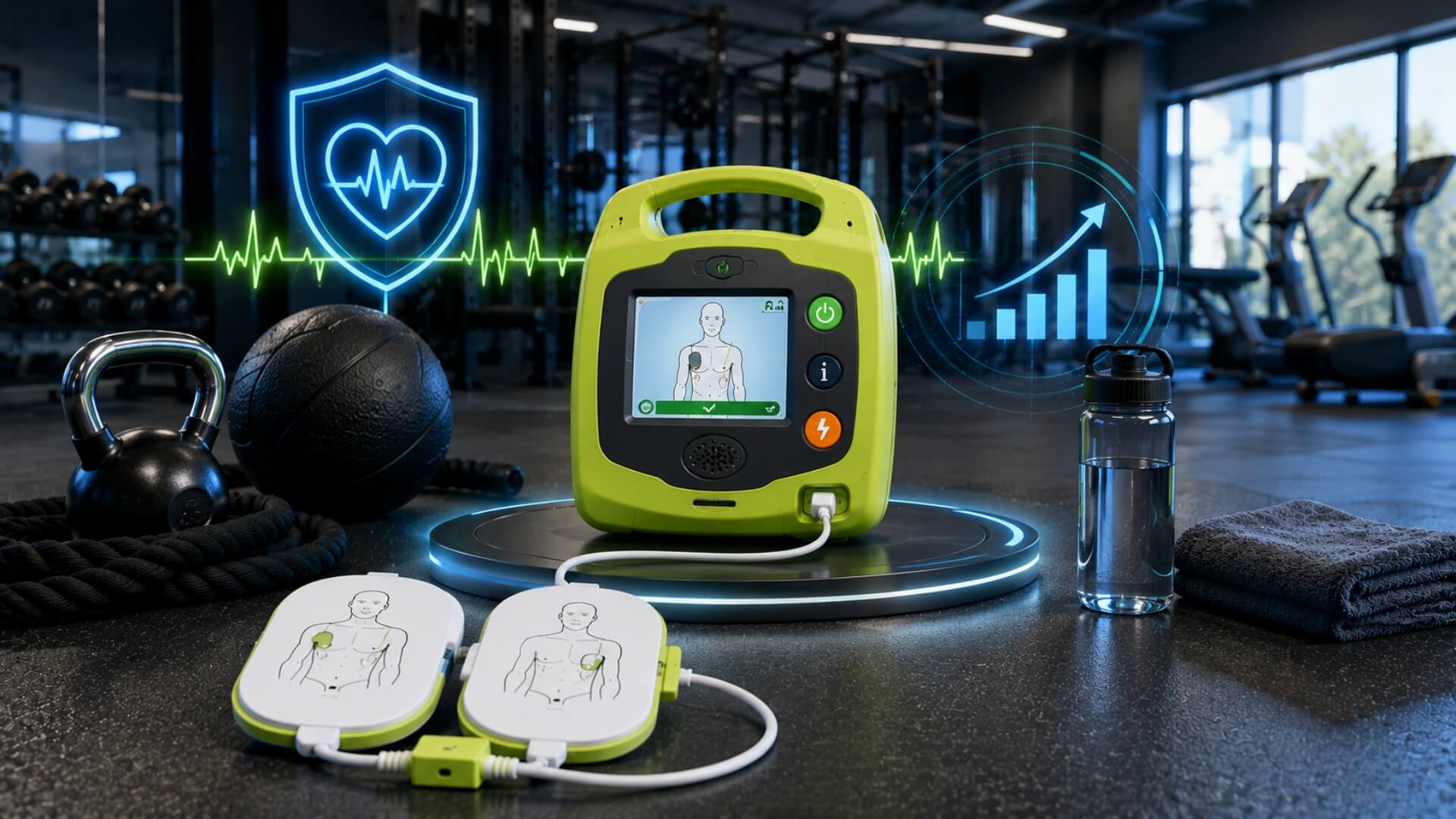
Sudden cardiac death is up to 17× more likely during vigorous exertion in habitually inactive individuals (NEJM 2000, Albert CM et al.), the exact population segment that walks into a commercial gym for the first time after a New Year’s resolution. The gym AED decision is the highest-stakes industry purchase in the AED market because the patient population is statistically more likely to need it.
32+ U.S. states mandate AEDs in fitness facilities, typically triggered at 50+ members or by facility square footage thresholds. The pick is not about the cheapest device, it is about which AED gives a panicked staff member the best chance of saving a 220-lb muscular member down on the cardio floor.
Quick answer
For gyms, the ZOLL AED 3 or ZOLL AED Plus is the standard pick, Real CPR Help® depth + rate coaching measurably improves compression quality on muscular adult patients. Cardiac Science Powerheart G5 is the runner-up when CPR coaching is needed, but Real CPR Help® is over-spec for the program. Pool-deck and outdoor facilities need IP55+ (G5 and AED Plus both qualify).
The exertion-SCA statistical reality
The NEJM 2000 Albert CM et al. study established that vigorous exertion increases the relative risk of sudden cardiac death by approximately 17× in habitually inactive individuals – a population that includes most new gym members in their first 90 days. Compounding factors: dehydration, electrolyte imbalance, undiagnosed structural heart disease, performance-enhancing substance use.
The implication for gym AED programs: the patient is statistically more likely to need CPR depth coaching than the general adult population, because compressions on a muscular chest require greater depth than the average rescuer naturally delivers under stress.
State law context for fitness facilities
32+ states mandate AEDs in commercial fitness facilities. Common triggers: 50+ members, $500+ annual member fees, square footage thresholds (typically 2,500+ sq ft). Several states also require a designated trained-responder plan and AED placement within specific time-to-reach standards.
States with broad fitness AED mandates: California, Florida, Illinois, Massachusetts, Nevada, New York, Rhode Island, and Maryland. Verify your state’s specific requirements via the AED Laws by State guide.
The 3 picks for gyms and fitness facilities
| Model | Price (2026) | CPR feedback | IP rating | 5-yr total | Best for |
|---|---|---|---|---|---|
| ZOLL AED 3 | $2,199 | Real CPR Help® depth + rate | IP55 | $2,400–$2,800 | Standard pick, multi-location chains, mixed-age |
| ZOLL AED Plus | $2,082 | Real CPR Help® depth + rate | IP55 | $2,000–$2,400 | Single-location commercial gym, adult only |
| Cardiac Science G5 | $1,799 | ICPR pads (optional) | IP55 | $2,100–$2,800 | Smaller studios + Rescue Ready® daily self-test priority |
Why CPR feedback changes gym rescue outcomes
The AHA 2020 Resuscitation Guidelines explicitly endorse real-time CPR feedback devices as improving compression depth and rate during cardiac arrest events. ZOLL’s CPR-D-padz and Uni-padz include accelerometers that measure compression depth and audibly coach the rescuer (“Push harder” / “Good compressions”).
For a 220-lb muscular gym member in cardiac arrest, the chest cavity offers significantly more resistance than that of the average adult. Untrained rescuers consistently undercompress under stress. ZOLL’s depth coaching closes that gap in real time, a measurable rescue performance advantage on exactly the population gyms are most likely to lose.
Coverage planning for fitness facilities
Gyms apply the AHA standard at the tightest coverage ratio of any indoor facility, approximately one AED per 10,000 sq ft of fitness floor due to the elevated SCA risk multiplier. Add one AED per pool deck (separate from the main floor). Add one AED per detached studio building.
| Facility size | AED count | Placement |
|---|---|---|
| 5,000 sq ft boutique studio | 1 AED | Front desk |
| 15,000 sq ft commercial gym | 2 AEDs | Front desk + cardio floor |
| 40,000 sq ft full-service club with pool | 4 AEDs | Front desk + cardio floor + free weights + pool deck |
| Multi-tower fitness chain location | 6+ AEDs | Per tower + per deck |
Real-world deployment scenario
15,000 sq ft commercial gym, ~1,800 members, indoor pool, 4 personal trainers + 2 front desk staff. Recommendation: 2 × ZOLL AED Plus (front desk + cardio floor) + 1 × HeartSine 360P (IP56 pool deck). Total 3-AED program: ~$5,200 device cost + ~$1,500 5-year consumables + ~$450 cabinets = ~$7,150 over 5 years. CPR + AED training for 6 staff: $300/year. Annual program total: ~$1,730/year amortized.
Verdict by gym profile
Multi-Location Chain · Mixed-Age · Fleet Program
ZOLL AED 3 with Uni-padz
Universal pad set covers adult + pediatric without swap workflow. ZOLL PlusTrac fleet management platform reduces program overhead across multiple locations.
Single-Location Commercial Gym · Adult Only
ZOLL AED Plus with CPR-D-padz
Real CPR Help® at a lower price point than AED 3. $400 saving funds CPR training renewals. The pick when pediatric is not required.
Frequently asked questions
Are AEDs legally required in commercial gyms?
In 32+ states, yes, typically triggered at 50+ members or specific square footage. Verify your state via the AED Laws by State guide.
Why is CPR feedback so important for gym AEDs?
SCA risk during vigorous exertion is up to 17× higher than baseline (NEJM 2000). The patient population is statistically more muscular than average, requiring greater compression depth, exactly the gap CPR feedback closes.
Does the AED need to be on the workout floor or at the front desk?
The AHA standard requires reachability within 3 minutes round-trip. For gyms over 10,000 sq ft, this typically requires at least one AED on the workout floor in addition to the front desk.
Does the pool deck need its own AED?
Yes, if the pool is more than 90 seconds walking distance from the nearest AED. Pool decks also benefit from IP56-rated devices (HeartSine 360P) due to humidity exposure.
How often should gym AEDs be inspected?
Monthly visual check minimum. Most gyms benefit from a paid service contract ($75–$150/yr) for compliance documentation, given the elevated liability profile.
Do trainers need to be CPR + AED certified?
Several states require it. AHA Heartsaver renewal cycle is 2 years. Per-person cost: $25–$75.
Run the math for your specific facility
Get the 60-second AED recommendation matched to your environment, training level, and budget. Free, no email required.
Sources
Educational guidance. State laws change. Verify current requirements with your state health department.