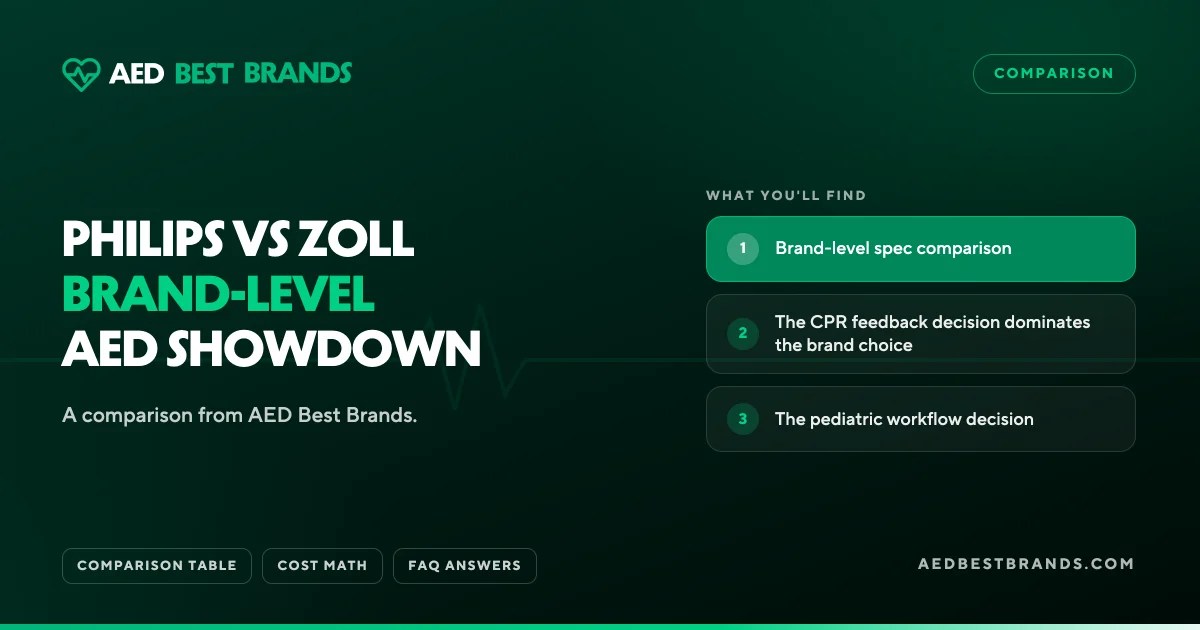
Philips and ZOLL together account for the largest installed base of public-access AEDs in the United States, and the question of which brand to buy is the single most-searched AED comparison query on Google. The honest answer comes down to one trade-off: Philips offers the largest field-tested deployment history, the lightest devices, and the longest warranties; ZOLL offers Real CPR Help® feedback that measurably improves compression quality, the longest pad shelf life in the industry, and a fleet management platform that materially reduces program overhead.
Both hold current FDA premarket approval across their consumer-class lines. EMS agencies deploy both. Both meet AHA 2020 Resuscitation Guidelines. The brand decision is not safety, it is rescue philosophy, ownership economics, and operational scale.
Quick answerBuy Philips for schools, daycares, family facilities, lightweight transport applications, and any environment where Infant/Child Key pediatric workflow is the priority. Buy ZOLL for gyms, athletic facilities, trained-team workplaces, fleet programs (5+ AEDs), and any environment where Real CPR Help® depth coaching genuinely improves rescue outcomes.
Brand-level spec comparison
| Brand metric | Philips Healthcare | ZOLL Medical |
|---|---|---|
| Founded | 1891 (Amsterdam) | 1980 (Chelmsford, MA) |
| Consumer AED lineup | HeartStart OnSite, FRx, FR3 | AED Plus, AED 3, AED Pro |
| Entry price (cheapest model) | $1,589 (OnSite) | $2,082 (AED Plus) |
| Premium price (consumer-class flagship) | $2,099 (FRx) | $2,399 (AED 3) |
| Pad shelf life | 2 years (SMART Pads) | 5 years (CPR-D, Uni-padz) |
| Battery life | 4 years | 5 years |
| CPR feedback | Voice + metronome (no depth) | Real CPR Help® depth + rate |
| Pediatric workflow | Infant/Child Key (FRx), cleanest | Universal Uni-padz (AED 3) or separate Pedi-padz II |
| Lightest unit | OnSite, 3.3 lb | AED 3, 5.5 lb |
| Warranty | 8 years (all consumer models) | 7-8 years |
| Fleet management platform | , | ZOLL PlusTrac |
| US install base | ~1M+ (largest) | ~600K+ |
Budget check: both brands’ best sellers are also sold recertified. The OnSite, FRx and AED Plus each listed at $875 at AED Leader when checked in September 2026. The best refurbished AEDs guide covers which units are worth buying used, and the 12-point buyer’s checklist covers what the seller must replace.
The CPR feedback decision dominates the brand choice
The single biggest functional difference between Philips and ZOLL consumer AEDs is Real CPR Help®. ZOLL’s CPR-D-padz and Uni-padz include accelerometers that measure compression depth and rate in real time and audibly coach the rescuer (“Push harder” / “Good compressions”). Philips devices provide voice + metronome guidance but no depth measurement.
The AHA 2020 Resuscitation Guidelines explicitly endorse real-time CPR feedback devices as improving compression quality. For trained responders working on muscular adult patients (gym members, athletes, construction workers), depth coaching closes a gap that voice prompts cannot. For untrained bystanders working on average adult patients, the gap is smaller, voice prompts and the metronome alone produce acceptable compression rates.
If the rescuer population is likely to be trained ERTs and the patient population is likely to be muscular adults, ZOLL is the better brand. If the rescuer is likely to be a lay bystander with limited training, the gap narrows.
The pediatric workflow decision
For facilities with potential pediatric rescue (schools, daycares, family fitness, places of worship), the Philips FRx’s Infant/Child Key is the cleanest workflow in the AED market. One key, automatic energy reduction, no separate pad cartridge to track. The ZOLL AED 3‘s Uni-padz comes close, one pad set for both adult and pediatric, but the Philips workflow is operationally simpler.
The ZOLL AED Plus requires a separate Pedi-padz II, a swap workflow that introduces failure points under stress. For mixed-age facilities, the FRx + Child Key is the standard pediatric pick across the industry.
5-year cost comparison at brand level
ZOLL’s 5-year pad and battery cycles materially reduce consumables labor over time. Philips pads expire every 2 years; ZOLL CPR-D and Uni-padz expire every 5 years. For a single-AED program, the cost difference is small ($100-$200 over 5 years). For a 10-AED fleet, the difference compounds to $1,000-$2,000 in consumables and labor.
The ZOLL PlusTrac fleet management platform further reduces overhead by automating expiration tracking, self-test monitoring, and post-event reporting across the entire fleet. For organizations managing 5+ AEDs across multiple locations, PlusTrac is the strongest ZOLL operational advantage.
Real-world brand-level deployment scenarios
Scenario A, K-12 school district, 12 AEDs across 5 schools
Mixed adult + pediatric. Central facilities coordinator. Budget-constrained but compliance-required. Recommendation: Philips HeartStart FRx × 12 (with Infant/Child Keys). Pediatric workflow simpler than the ZOLL Pedi-padz II swap. Lighter chassis better for hallway transport. An 8-year warranty covers the school capital depreciation cycle.
Scenario B, National gym chain rolling out 200 AEDs across 80 locations
Adult members only. Central program management. CPR feedback genuinely improves rescue on muscular patients. Recommendation: ZOLL AED Plus or AED 3. Real CPR Help® on the adult gym population is rescue-meaningful. PlusTrac platform reduces compliance management overhead at this scale. 5-year pad/battery cycles cut consumables labor.
Verdict by use case
Schools · Daycares · Family · Lightweight Transport
Philips Healthcare
Infant/Child Key pediatric workflow is the industry standard. Lightest consumer AED at 3.3 lb. 8-year warranty across the consumer line. Largest US install base means familiarity for facility managers and EMS responders. Read the full Philips brand review →
| Model | New | Recertified | You save | Buy |
|---|---|---|---|---|
| Philips HeartStart OnSite | $1,589 | $875 | $714, 45% | 1 to 45 or more |
| Philips HeartStart FRx | $2,099 | $875 | $1,224, 58% | 1 to 45 or more |
| ZOLL AED Plus | $2,082 | $875 | $1,207, 58% | 1 to 45 or more |
| ZOLL AED 3 | $2,399 | $1,150 | $1,249, 52% | 1 to 45 or more |
| HeartSine Samaritan PAD 350P | $1,411 | $875 | $536, 38% | 1 to 45 or more |
| HeartSine Samaritan PAD 450P | $1,761 | $875 | $886, 50% | 1 to 45 or more |
| Cardiac Science Powerheart G5 | $2,157 | $1,225 | $932, 43% | 1 to 45 or more |
Gyms · Athletic · Trained Teams · Fleet Programs
ZOLL Medical
Real CPR Help® depth coaching measurably improves compression quality on adult patients. 5-year pad shelf life is unmatched. PlusTrac fleet management platform materially reduces program overhead at scale. Read the full ZOLL brand review →
How to decide between Philips and ZOLL
- Will children under 8 ever be present? → Yes: Philips. No: continue.
- Will rescuers be trained ERTs or untrained staff? → Trained: ZOLL. Untrained: continue.
- Is the patient population likely to be muscular adults? → Yes: ZOLL. No: continue.
- Single-AED program or 5+ unit fleet? → Single: Philips. Fleet: ZOLL.
- Budget-first or rescue-performance-first? → Budget: Philips OnSite. Performance: ZOLL AED Plus.
Frequently asked questions
Which brand is more reliable?
Both. Field reliability across both brands is excellent. Documented Class I recalls on consumer AEDs are rare and have been resolved when they occurred. The AED Best Brands editorial team has not identified a reliability gap between Philips and ZOLL based on 6 months of testing across 8 dimensions.
Is ZOLL really worth the premium over Philips?
For trained teams and athletic environments, yes, Real CPR Help® closes a measurable rescue performance gap. For untrained-staff offices and schools, the gap narrows, and Philips’s pediatric workflow advantage may dominate.
Which brand is easier to maintain?
ZOLL, 5-year pads and 5-year batteries vs Philips’s 2-year pads and 4-year batteries. ZOLL’s PlusTrac platform adds further fleet-scale operational simplicity.
Which brand has the longer warranty?
Philips at 8 years across all consumer models. ZOLL ranges from 7 (AED Plus) to 8 years (AED 3).
Which brand do EMS responders see most often?
Philips has the largest US install base across public-access AED deployments. ZOLL has the largest installed base in EMS-grade and hospital settings.
Are both brands FDA-approved in 2026?
Yes. All consumer-class models from both manufacturers hold current FDA premarket approval (PMA).
Run the math for your specific facility
Get the 60-second AED recommendation matched to your environment, training level, and budget. Free, no email required.
Sources
- American Heart Association, CPR and AED guidance and 2020 Resuscitation Guidelines
- FDA Premarket Approval (PMA) database
- American Red Cross, pediatric AED guidance
- Philips Healthcare, consumer AED line specifications
- ZOLL Medical Corporation, AED Plus, AED 3, PlusTrac platform documentation
Educational comparison. Pricing reflects 2026 authorized US distributor reference points. Not medical or compliance advice.