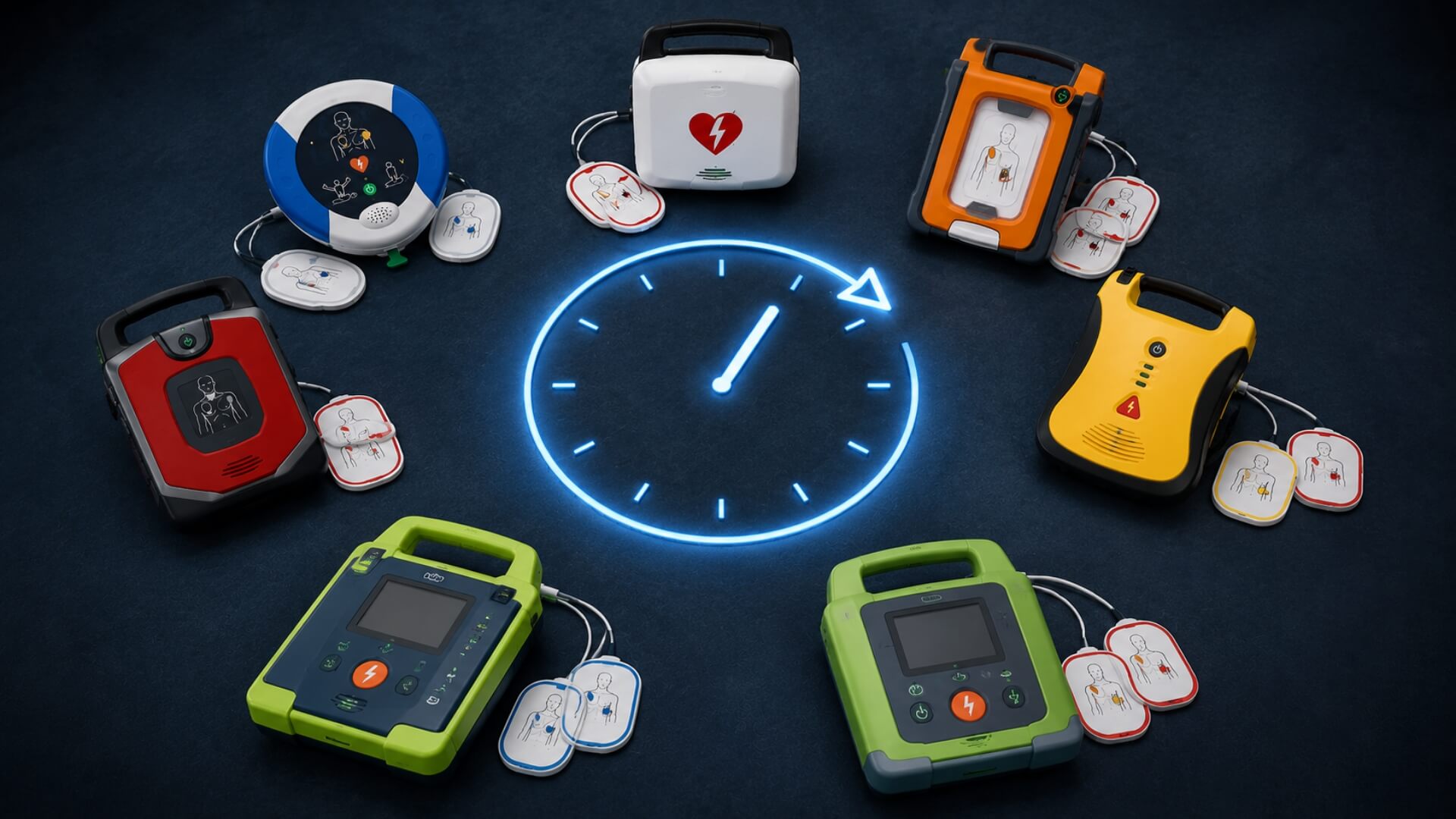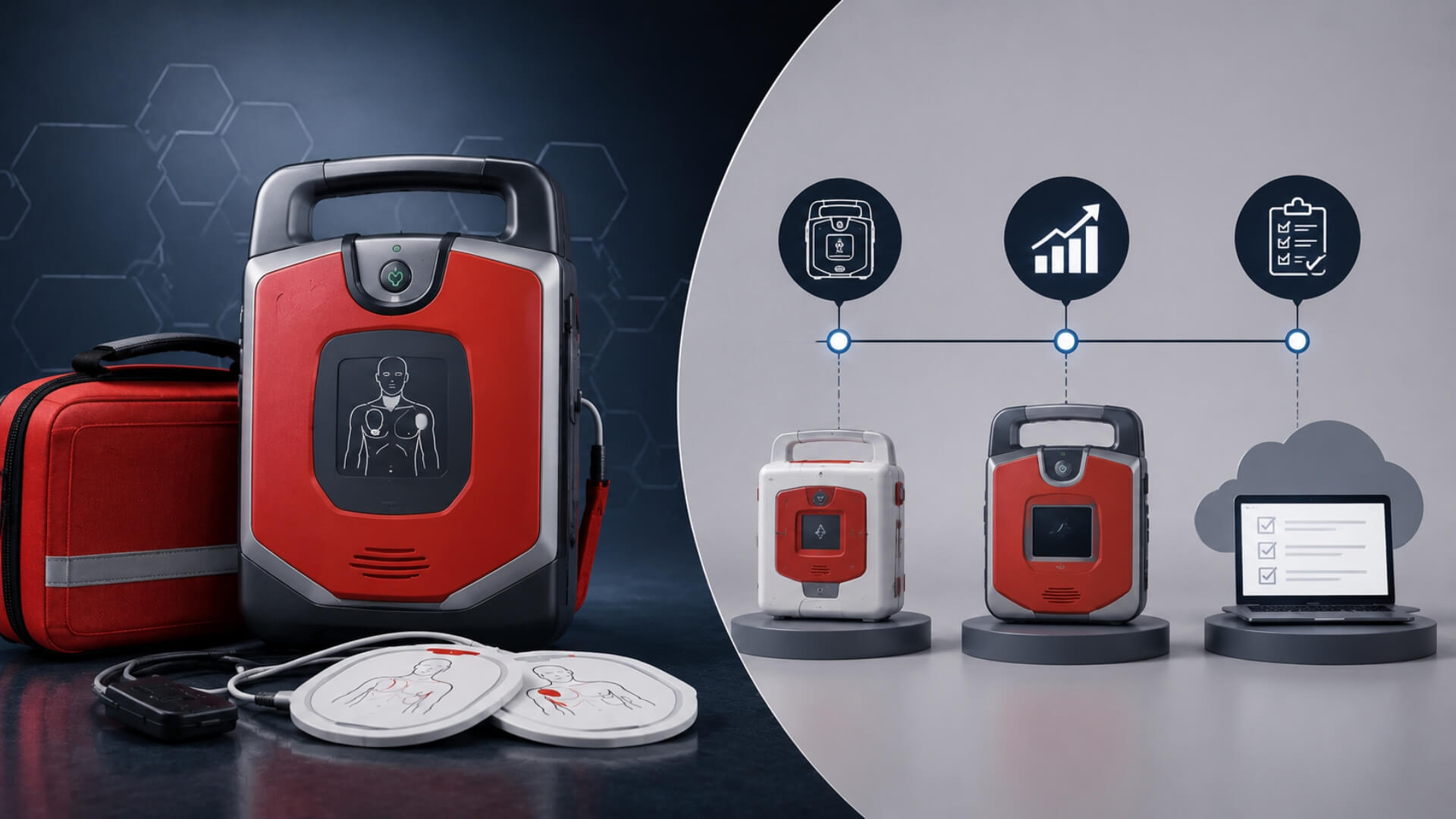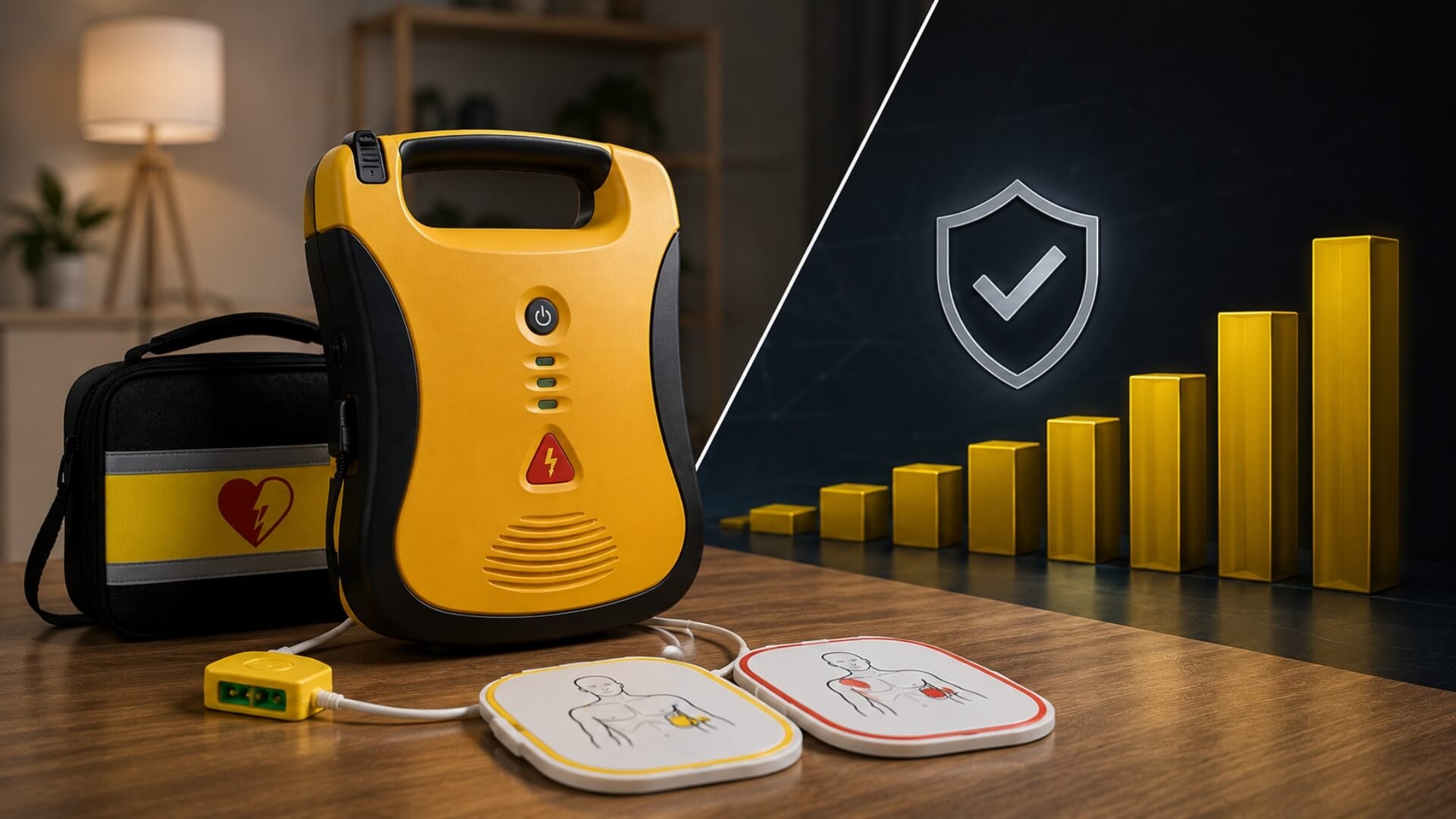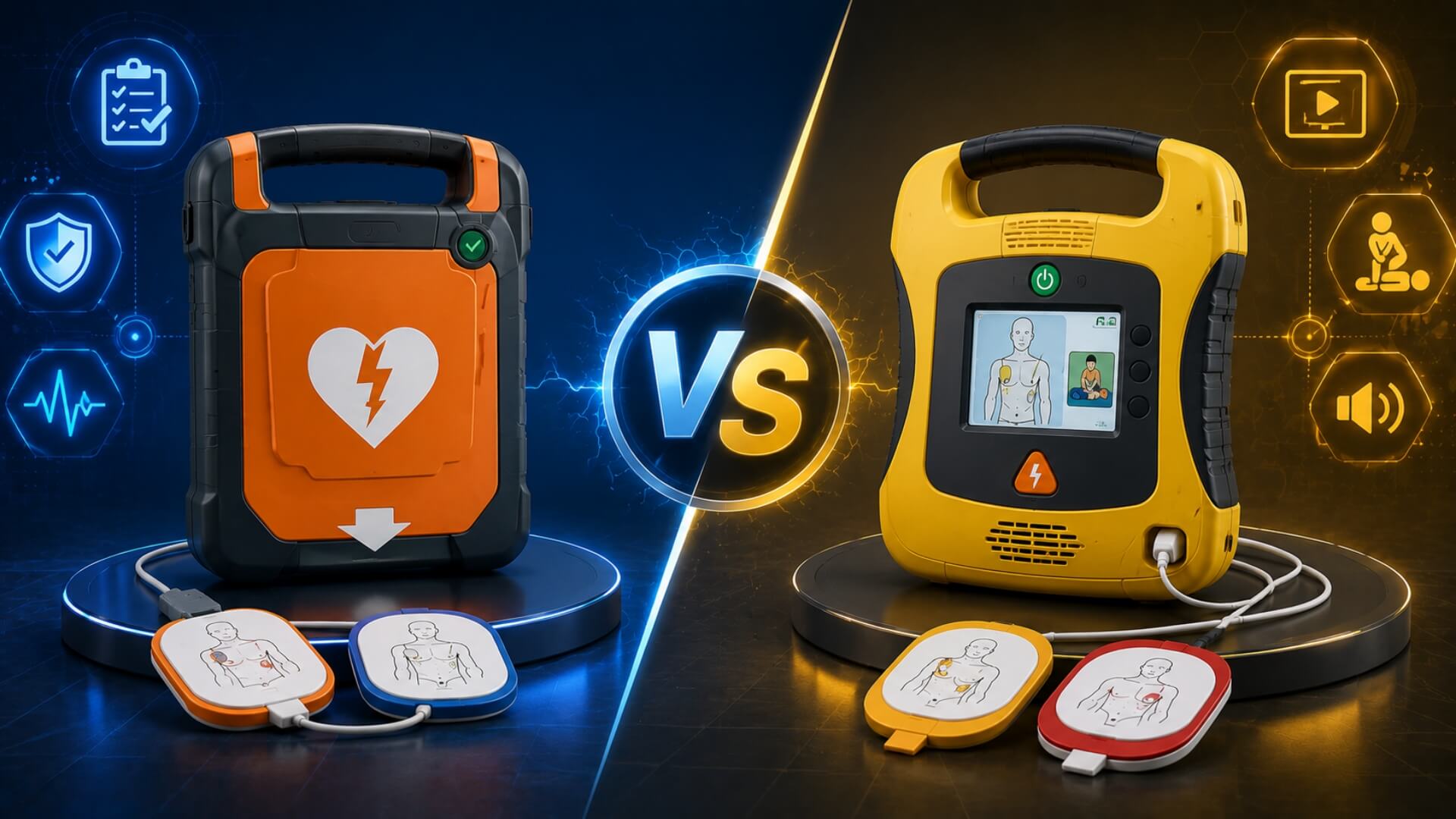
The Cardiac Science Powerheart G5 and Defibtech Lifeline View are the two most-deployed AEDs in the 8-year warranty class — and they answer the same buyer question with completely different engineering. The G5 leans into automation: Rescue Ready® daily self-test confirms device readiness without any human action. The Lifeline View leans into rescue guidance: a full-color video screen walks the rescuer through every step with moving images.
Buyers comparing these two are usually picking between operational simplicity (set it on the wall, forget it for 8 years) and rescue confidence (an untrained bystander gets video instructions during the worst moment of someone’s life).
Quick answerThe G5 wins for facilities prioritizing maintenance simplicity and trained-team environments — Rescue Ready® daily self-test is the deepest automated readiness check available, and built-in pediatric mode is one button. The Lifeline View wins for high-staff-turnover environments and locations with untrained or panicked rescuers — the video screen materially reduces rescuer hesitation in the first 30 seconds.
Head-to-head spec comparison
| Spec | Cardiac Science Powerheart G5 | Defibtech Lifeline View |
|---|---|---|
| Retail price (2026) | $1,799 | $1,695 |
| Pad shelf life | 2 years (standard) / 2 yr (ICPR) | 2 years |
| Battery life | 4 years | 4 years |
| CPR feedback | ICPR pads (optional, real-time) | Video instruction only |
| Pediatric mode | Built-in child mode (one button) | Separate pediatric pad set |
| Self-test | Rescue Ready® daily auto self-test | Periodic self-test |
| Display | Status LED only | Full-color video screen |
| IP rating | IP55 | IPX4 (lower) |
| Shock delivery | Semi or fully automatic (model dependent) | Semi-automatic only |
| Warranty | 8 years | 8 years |
| 5-year total ownership cost | $2,100–$2,800 | $1,800–$2,400 |
Rescue Ready® — what the daily self-test actually does
The Powerheart G5 runs a complete self-test every 24 hours. The test verifies battery charge, pad connection, internal circuitry, and shock-delivery capability. If anything fails, the device alerts via flashing red indicator. Cardiac Science is the only manufacturer that runs a true daily check at this depth.
For facilities without a dedicated AED program manager — small businesses, churches, single-location offices — Rescue Ready® removes the most common AED failure mode: a device that was assumed to be working but wasn’t. Standard self-test cycles run weekly or monthly and miss the window between cycles.
The video screen — does it actually help rescuers?
The Lifeline View’s color screen displays moving video instructions for every rescue step: pad placement, hand position for CPR, compression rhythm, and when to clear. For untrained bystanders in their first 30 seconds of a real cardiac event, the cognitive load is severe — voice prompts alone are processed inconsistently under acute stress.
Field deployment data from emergency services agencies cites the video display as the single most-mentioned positive in lay-rescuer post-event interviews on Defibtech devices. For hotels with high front-desk turnover, public-access deployments in transit hubs, and multilingual environments where voice may be missed, the visual layer is genuinely valuable.
Pediatric workflow comparison
The G5 has a built-in child mode button. Press once, energy reduces to pediatric levels. No separate pad cartridge. The Lifeline View requires a separate pediatric pad set — Lifeline DDP-100P — that must be physically swapped onto the device. For facilities with children, the G5’s one-button workflow is faster and harder to fumble under stress.
IP rating and outdoor reality
IP55 (G5) protects against jet water from any direction. IPX4 (Lifeline View) protects against water splash from any direction but not jets. For outdoor athletic fields, pool decks, and humid environments, the G5 is the better-rated device. The Lifeline View should stay indoors or in protected enclosures.
Real-world deployment scenarios
Scenario A — 250-room hotel with 24/7 front desk, high staff turnover
Multilingual guests, untrained desk staff, rescue likely conducted by the first-arriving employee. Recommendation: Defibtech Lifeline View. Video instructions reduce rescuer hesitation. Color screen draws and holds attention during the highest-stress moment. Periodic self-test is acceptable for facilities with a designated AED program contact.
Scenario B — Small church (350 members), one trained responder (the pastor’s wife is a nurse), volunteer ushers
Older congregation. AED is checked occasionally. Designated responder available most Sundays, but not all events. Recommendation: Cardiac Science Powerheart G5. Rescue Ready® daily self-test eliminates the “is the AED working?” question between checks. Built-in pediatric mode covers children’s programs. Fully-automatic option removes shock-button hesitation for volunteer ushers if needed.
Verdict by use case
Hotels · Public-Access · High-Turnover · Multilingual
Defibtech Lifeline View
The video screen is genuinely useful when the rescuer is untrained, stressed, or non-native English-speaking. The first 30 seconds of a real cardiac event are visual, not auditory. Read the full Lifeline View review →
Churches · Small Office · Schools (Adult Programs) · Trained-Team Workplaces
Cardiac Science Powerheart G5
Rescue Ready® daily self-test is the closest thing to “set it and forget it” in the AED market. Built-in pediatric mode + 8-year warranty + IP55 outdoor rating round out the package. Read the full G5 review →
Frequently asked questions
Which is cheaper to own over 5 years?
The Lifeline View by roughly $200. Both require similar pad + battery replacements over 5 years, but the G5’s slightly higher retail price carries through.
Does the G5 have a video screen?
No. The G5 uses a status LED and audio voice prompts. The Lifeline View’s video screen is unique among 8-year warranty AEDs.
Can the Lifeline View be used outdoors?
Only with cabinet protection. The IPX4 rating handles splash but not direct weather. For outdoor deployment, choose HeartSine 360P (IP56).
Which is faster to set up for pediatric rescue?
The G5 — one button press. The Lifeline View requires swapping to a separate pediatric pad set.
Does Rescue Ready® require any user action?
No. The daily self-test runs automatically at the same time each day. A failure triggers a flashing red indicator visible from across a room.
Are both FDA-cleared in 2026?
Yes. Both hold active 510(k) clearance. Verify in the FDA database before purchase.
Run the math for your specific facility
Get the 60-second AED recommendation matched to your environment, training level, and budget. Free, no email required.
Sources
- American Heart Association — CPR + AED guidance
- FDA 510(k) database
- Cardiac Science — Powerheart G5 Rescue Ready® specifications
- Defibtech — Lifeline View product documentation and rescuer-interface design notes
Educational comparison. Pricing reflects 2026 authorized US distributor reference points. Not medical, legal, or compliance advice.