An AED with an expired battery is a wall ornament. Battery state is the second-most-common consumables failure mode after pad expiration, and it has the same cause: nobody set a calendar reminder. The good news is battery cycles are predictable, and the replacement workflow is straightforward.
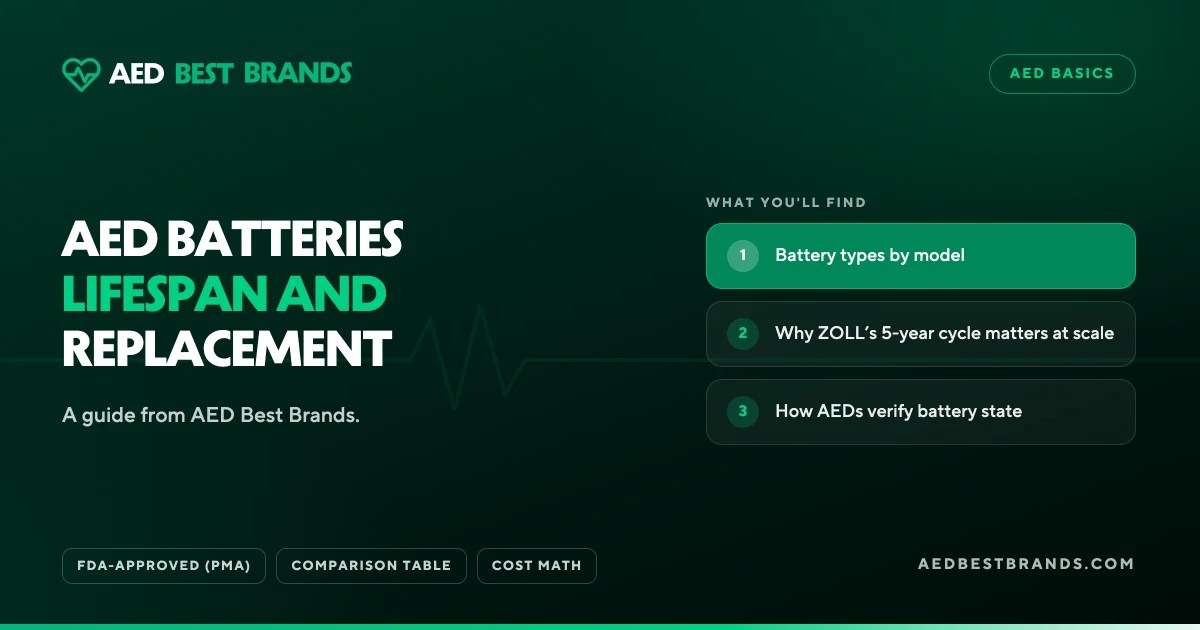
AED batteries last 2–5 years, depending on the model. ZOLL AED 3 and AED Plus batteries last 5 years, the longest standard cycle. HeartSine Pad-Pak combines battery + pads into one 4-year cartridge. Most Philips, Defibtech, and Cardiac Science batteries last 4 years. Replacement costs $100–$495, depending on brand.
Fleet refresh: pads and batteries for every AED, on one screen
Own more than one AED, or more than one brand? Find each model below, enter how many you have, and see the refresh cost and the buy link for every part. Prices from AED Leader, checked 25 September 2026.
| Your AED | Adult pads | Battery | Child pads (if needed) | Refresh set per AED | How many? |
|---|---|---|---|---|---|
| Philips HeartStart OnSite | M5071A adult pads $99 every 2 yr Buy pads | M5070A battery $249 every 4 yr Buy battery | M5072A infant/child pads $139 Buy | $348 | |
| Philips HeartStart FRx | SMART Pads II $89 every 2 yr Buy pads | M5070A battery $249 every 4 yr Buy battery | Uses an infant/child key | $338 | |
| ZOLL AED Plus | CPR-D-padz $230 every 5 yr Buy pads | 10 x 123A lithium batteries $100 every 5 yr Buy battery | Pedi-padz II $155 Buy | $330 | |
| ZOLL AED 3 | CPR Uni-padz (adult and child) $234 every 5 yr Buy pads | 8000-000696 battery $201 every 5 yr Buy battery | Adult pads also cover children | $435 | |
| HeartSine samaritan 350P / 360P / 450P | Pad-Pak 01 (pads and battery in one) $236 every 4 yr Buy pads | Included in the Pad-Pak | Pediatric Pad-Pak $279 Buy | $236 | |
| Defibtech Lifeline | DDP-100 adult pads $75.15 every 2 yr Buy pads | DBP-1400 battery $229.10 every 5 yr Buy battery | DDP-200P pediatric pads $130.25 Buy | $304.25 | |
| Defibtech Lifeline VIEW | DDP-2001 adult pads $83.05 every 2 yr Buy pads | DCF-2003 battery $240.45 every 5 yr Buy battery | DDP-2002 pediatric pads $136.40 Buy | $323.50 | |
| Cardiac Science Powerheart G5 | XELAED001C adult pads $88 every 2 yr Buy pads | XBTAED001A battery $495 every 4 yr Buy battery | XELAED003C pediatric pads $127 Buy | $583 | |
| LIFEPAK CR2 | QUIK-STEP pads (adult and child) $196 every 4 yr Buy pads | CR2 lithium battery $341 every 4 yr Buy battery | Adult pads also cover children | $537 |
Why it matters: an AED with expired pads or a flat battery may not shock when it is needed, and pads must be replaced after any use. The printed expiry date on each part always overrides the typical life shown here. Buying 5 or more units? Ask AED Leader for a quote.
Battery types by model
| AED | Battery type | Shelf life | Replacement cost |
|---|---|---|---|
| Philips HeartStart OnSite | Lithium primary (M5070A) | 4 years | $249 |
| Philips HeartStart FRx | Lithium primary (M5070A) | 4 years | $249 |
| ZOLL AED Plus | 10× type 123A lithium | 5 years | $100 |
| ZOLL AED 3 | Lithium primary, non-rechargeable | 5 years | $201 |
| LIFEPAK CR2 | Lithium primary | 4 years | ~$200 |
| HeartSine 350P/360P/450P | Combined Pad-Pak | 4 years | $236 (combined w/ pads) |
| Cardiac Science G5 | Lithium primary | 4 years | $495 |
| Defibtech Lifeline View | Lithium primary | 4 years | $240.45 |
Why ZOLL’s 5-year cycle matters at scale
ZOLL’s 5-year battery cycle, combined with 5-year CPR-D-padz/Uni-padz, means a ZOLL AED Plus or AED 3 can run 5 years between any consumables event if no rescue occurs. For a 10-AED fleet program, this cuts roughly 60% of consumables-tracking labor over 5 years vs Philips’s 2-year pad cycle + 4-year battery cycle.
This is why most enterprise AED fleet programs (healthcare systems, multi-location gyms, school districts with 20+ AEDs) default to ZOLL, the maintenance overhead reduction compounds.
How AEDs verify battery state
Most modern AEDs run automatic self-tests that include a battery voltage check. Cardiac Science’s Rescue Ready® runs the most comprehensive daily check. ZOLL and Philips devices run periodic checks (typically weekly or monthly). A failed battery triggers a visible red indicator on the device.
This does not mean buyers can skip manual inspection. Self-tests verify voltage but cannot predict when the battery will fall below the threshold in the next 30 days. Calendar-driven replacement based on installed date + manufacturer’s shelf life is the correct workflow.
Tracking expiration across a fleet
For 1–4 AED programs: calendar reminders 30 days, 7 days, and 1 day before expiration. Most missed replacements are reminder failures.
For 5+ AED programs: fleet management platforms (ZOLL PlusTrac, Response Ready) automate tracking and alert ahead of expiration. Annual cost typically $75–$150 per AED, offset by avoided expired-battery rescue failures.
AED battery replacement prices, checked 24 September 2026
At AED Leader on 24 September 2026: the Philips HeartStart M5070A battery for the OnSite is $249, the HeartSine Pad-Pak 01 with pads and battery in one cartridge is $236, the ZOLL AED 3 non-rechargeable 5-year battery is $201 and the Defibtech DBP-1400 standard battery is $229.10. Divide the price by the rated life to budget per year: the ZOLL AED 3 battery works out at about $40 a year over five years.
Recertified AEDs from $875: the 7 models that sell
Same FDA-approved (PMA) hardware for 38% to 58% less than new, each with a 3-year seller warranty at AED Leader. Prices checked 4 October 2026.
| Recertified model | Price | New | You save | Buy |
|---|---|---|---|---|
| Philips OnSite recertified | $875 | $714 (45%) | Check price | |
| Philips FRx recertified | $875 | $1,224 (58%) | Check price | |
| ZOLL AED Plus recertified | $875 | $1,207 (58%) | Check price | |
| ZOLL AED 3 recertified | from $1,150 | $1,249 (52%) | Check price | |
| HeartSine 450P recertified | $875 | $886 (50%) | Check price | |
| HeartSine 350P recertified | $875 | $536 (38%) | Check price | |
| Powerheart G5 recertified | $1,225 | $932 (43%) | Check price |
Buying 5 or more? Response Ready handles fleet orders. Compare all of them in the best refurbished AEDs.
Frequently asked questions
How long do AED batteries last?
2–5 years, depending on model. ZOLL AED Plus and AED 3 lead at 5 years.
How much does AED battery replacement cost?
$100–$495 depending on brand. ZOLL AED Plus battery: $100. ZOLL AED 3 battery: $201.
Will the AED warn me when the battery is low?
Yes. Most AEDs display a visible red indicator and beep when battery voltage falls below a threshold. Don’t rely on this alone, set calendar reminders.
Can I use an AED with an expired battery?
Possibly, briefly, but the device may not deliver therapy correctly. Replace expired batteries immediately.
Do AED batteries need to be recycled?
Yes. Lithium batteries should be recycled via authorized e-waste programs. Most authorized distributors accept battery returns with a new purchase.
How do I install a new AED battery?
Open the device, remove the old battery (typically a single-button release), and insert the new battery in the correct orientation. Most devices run a self-test after battery installation to verify proper operation.
Run the math for your specific facility
Get the 60-second AED recommendation matched to your environment, training level, and budget. Free, no email required.
Sources
- Manufacturer specifications, Philips, ZOLL, HeartSine, LIFEPAK, Cardiac Science, Defibtech
- AHA, CPR + AED guidance
Educational content. Pricing reflects 2026 authorized distributor reference points.