California has roughly 39 million residents and ~28,000 out-of-hospital cardiac arrests per year. The state’s AED legal framework is among the broadest in the nation, covering K-12 schools, health studios, and public-access defibrillation programs with explicit Good Samaritan protection layered across all three.
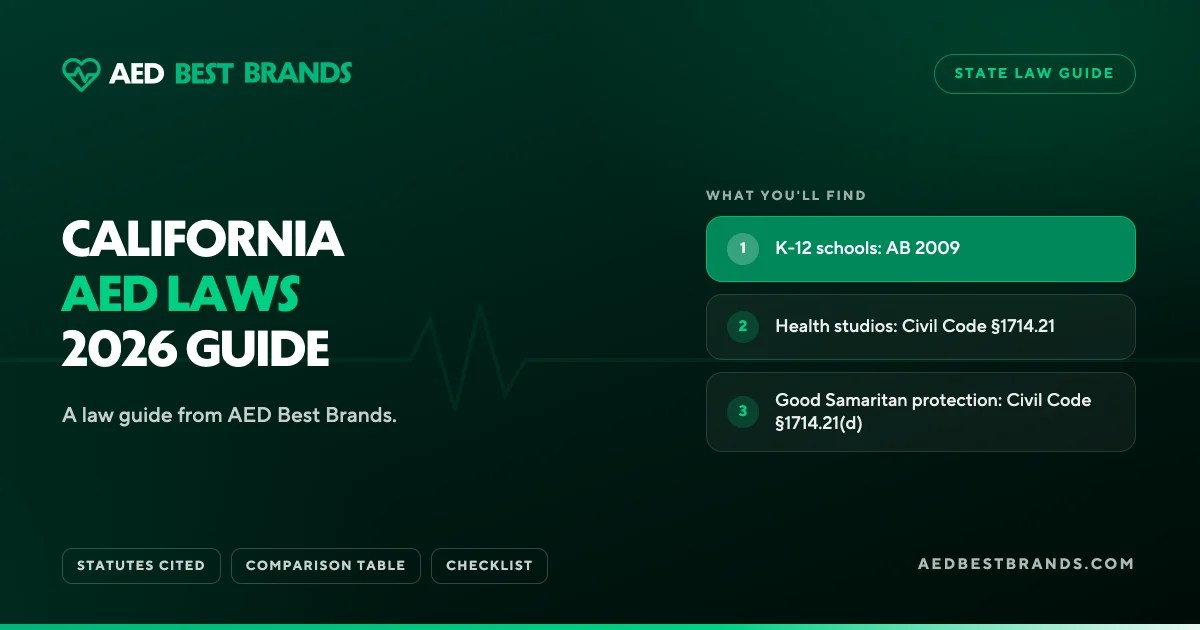
California requires AEDs in K-12 schools (AB 2009, effective 2020) and in health studios with 200+ members (Civil Code §1714.21 and Health & Safety Code §104113). Good Samaritan protection covers rescuers, AED owners, and trainers acting in good faith. AED owners must maintain devices per the manufacturer’s specs and notify local EMS of installation.
K-12 schools, AB 2009
California Education Code §35179.4 (enacted via AB 2009) requires every K-12 school that has interscholastic athletic programs to have an AED on campus during athletic events and practices. Schools must also have a written emergency action plan and at least one staff member trained in CPR + AED.
Coverage
All public K-12 schools with athletic programs
Location
Available during athletic events + practices
Training
At least one CPR + AED-trained staff member
Plan
Written emergency action plan required
Health studios, Civil Code §1714.21
California Civil Code §1714.21 and Health & Safety Code §104113 require health studios with 200+ members to have at least one AED on premises. Facilities must train staff annually in CPR + AED use and post the AED location prominently. The law applies to traditional gyms, fitness centers, and most membership-based exercise facilities.
Good Samaritan protection, Civil Code §1714.21(d)
California’s Good Samaritan AED law is one of the broadest in the country. Protection extends to: lay rescuers using an AED in good faith; AED owners who maintained the device properly; CPR + AED trainers who provided instruction; and facilities that made the AED available. Protection applies to civil and (in limited cases) criminal liability for rescuers acting without gross negligence.
Registration requirements
California requires AED owners to notify local EMS of installation. Most counties accept online registration through their EMS Agency portal. Notification must include device location, model, and contact information for the responsible party. Updates required when devices are relocated or removed.
Maintenance requirements
AED owners must maintain devices per manufacturer specifications: monthly visual inspection, replacement of pads/batteries before expiration, and prompt response to self-test alarms. Failure to maintain may void the Good Samaritan owner protection in the event of device failure during rescue.
California compliance checklist
| Model | New | Recertified | You save | Buy |
|---|---|---|---|---|
| Philips HeartStart OnSite | $1,589 | $875 | $714, 45% | 1 to 45 or more |
| Philips HeartStart FRx | $2,099 | $875 | $1,224, 58% | 1 to 45 or more |
| ZOLL AED Plus | $2,082 | $875 | $1,207, 58% | 1 to 45 or more |
| ZOLL AED 3 | $2,399 | $1,150 | $1,249, 52% | 1 to 45 or more |
| HeartSine Samaritan PAD 350P | $1,411 | $875 | $536, 38% | 1 to 45 or more |
| HeartSine Samaritan PAD 450P | $1,761 | $875 | $886, 50% | 1 to 45 or more |
| Cardiac Science Powerheart G5 | $2,157 | $1,225 | $932, 43% | 1 to 45 or more |
| Requirement | Applies to | Status |
|---|---|---|
| AED on premises | K-12 athletic programs, gyms, 200+ members | Required |
| Staff training | At least one trained staff member | Required |
| Emergency action plan | K-12 schools | Required |
| EMS notification | All AED owners | Required |
| Annual maintenance | All AED owners | Required |
| Public-access signage | Buildings with AEDs | Recommended |
Frequently asked questions
Do all California schools need AEDs?
K-12 schools with interscholastic athletic programs are required under AB 2009. Schools without athletic programs are encouraged but not mandated.
What gyms in California need an AED?
Health studios with 200+ members per Civil Code §1714.21. Smaller facilities are encouraged but not mandated.
Can I be sued for using an AED in California?
Highly unlikely. California has among the broadest Good Samaritan protections in the country, covering rescuers, owners, and trainers acting in good faith.
Do I need to register my AED with California EMS?
Yes. Notify your local county EMS Agency of installation. Most counties accept online registration.
How often do I need to inspect my California AED?
Monthly visual inspection minimum. Replace pads and batteries per the manufacturer’s schedule.
Run the math for your specific facility
Get the 60-second AED recommendation matched to your environment, training level, and budget. Free, no email required.
Sources
- California Education Code §35179.4 (AB 2009)
- California Civil Code §1714.21, AED Good Samaritan protection
- California Health & Safety Code §104113, Health studio AED requirements
- California EMS Authority
Educational content. Not legal advice. Verify current statute with the California EMS Authority or qualified counsel.