Sudden cardiac arrest kills approximately 350,000 Americans every year outside hospitals (CDC). The single device that materially changes survival outcomes during the first 3 minutes of a cardiac event is the automated external defibrillator, and most people who could legally buy one don’t know they can.
Quick answer
An automated external defibrillator (AED) is a portable medical device that analyzes a patient’s heart rhythm and delivers an electrical shock if the rhythm is shockable. The device handles the decision, the rescuer does not interpret an ECG. Modern AEDs guide untrained bystanders through every rescue step with voice prompts. As of 2022, no prescription is required to purchase one in the United States.
What an AED actually does
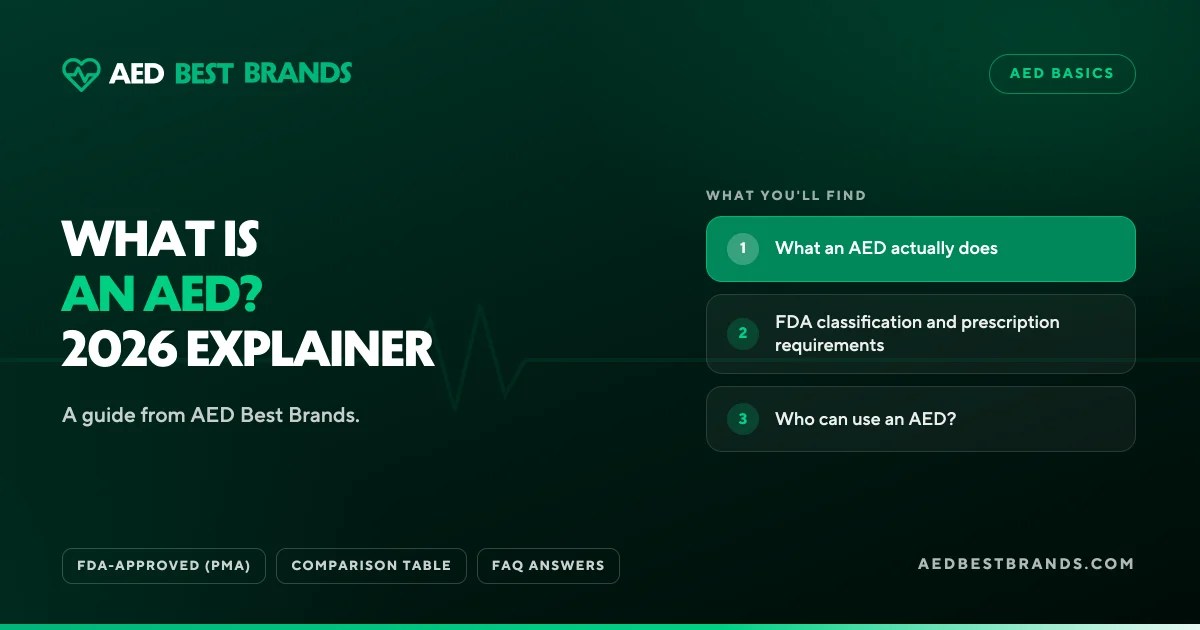
An AED performs three functions during a cardiac event: it analyzes the patient’s heart rhythm via adhesive electrode pads, determines whether the rhythm is shockable (ventricular fibrillation or pulseless ventricular tachycardia), and delivers a calibrated electrical shock if defibrillation is indicated. The device does not shock a patient whose rhythm is not shockable, making AEDs safe for use by untrained bystanders.
What an AED does not do: it does not restart a stopped heart, it does not treat heart attacks (myocardial infarctions), and it does not replace CPR. AED + CPR + EMS response is the rescue triad, no single component substitutes for the others.
FDA classification and prescription requirements
The FDA classifies AEDs as Class III medical devices, regulated under the Premarket Approval (PMA) pathway (FDA). Every AED sold in the United States must hold current premarket approval and appear in the FDA’s public PMA database.
As of 2022, the FDA reclassified all AEDs as accessible without a prescription for general public use. Any FDA-approved AED can be purchased directly by individuals, businesses, schools, and public facilities. Verify that any model is currently listed in the FDA Premarket Approval (PMA) database before purchase.
Who can use an AED?
Anyone. Every FDA-approved AED is designed for use by untrained bystanders with voice prompts at every step. Good Samaritan laws in all 50 U.S. states protect bystanders acting in good faith without intent to harm (AHA). No medical training is legally required to use an AED in the United States.
CPR + AED certification is not legally required, but meaningfully improves outcomes. AHA Heartsaver certification runs ~30 minutes and is available through providers like AED Leader training.
The brands you can actually buy
| Brand | Founded | Consumer lineup | Entry price (2026) |
|---|---|---|---|
| Philips Healthcare | 1891 (Amsterdam) | HeartStart OnSite, FRx, FR3 | $1,589 |
| ZOLL Medical | 1980 (Chelmsford, MA) | AED Plus, AED 3, AED Pro | $2,082 |
| LIFEPAK (Stryker) | 1955 (Kalamazoo, MI) | CR2 Essential, CR2 Connected | $2,256 |
| HeartSine (Stryker) | 1998 (Belfast, UK) | Samaritan PAD 350P, 360P, 450P | $1,411 |
| Cardiac Science | 2001 (Irvine, CA) | Powerheart G3, G5 | $2,082 |
| Defibtech | 2000 (Guilford, CT) | Lifeline, Lifeline View | $1,478.80 |
What an AED does not do
An AED treats shockable cardiac rhythms (ventricular fibrillation, pulseless ventricular tachycardia). It does not treat asystole (flat-line), bradycardia (slow heart), or pulseless electrical activity. The device will explicitly state “No shock advised” when the rhythm is not shockable, and the rescuer continues CPR.
An AED is not a substitute for CPR. Compressions maintain blood flow to the brain during the rescue. AED + CPR together produce dramatically better outcomes than either alone (AHA).
Frequently asked questions
Do I need a prescription to buy an AED?
No. As of 2022, the FDA reclassified all AEDs as accessible without a prescription for general public use.
Can an AED hurt someone if used incorrectly?
The device will not deliver a shock unless a shockable rhythm is detected. AEDs are designed to be safe for untrained bystander use.
How much does an AED cost in 2026?
FDA-approved AED devices range from $1,411 (HeartSine 350P) to $2,399 (ZOLL AED 3). Mid-range is $1,400–$1,800. Run the Cost Calculator for full 5-year math.
Will Good Samaritan laws protect me if I use an AED?
Yes. All 50 U.S. states have Good Samaritan AED protections for bystanders acting in good faith without intent to harm.
Does an AED treat a heart attack?
No. Heart attacks (blocked coronary arteries) require hospital treatment. AEDs treat sudden cardiac arrest (electrical malfunction), see SCA vs Heart Attack for the full distinction.
Where should I buy an AED?
From an authorized U.S. distributor – AED Leader or Response Ready. Avoid gray-market resellers (warranty void, recall risk).
Pediatric-first AED procurement
The free quiz routes daycare-profile buyers to the right pediatric-capable model.
Sources
Educational content. Not medical advice. In a medical emergency, call 911.