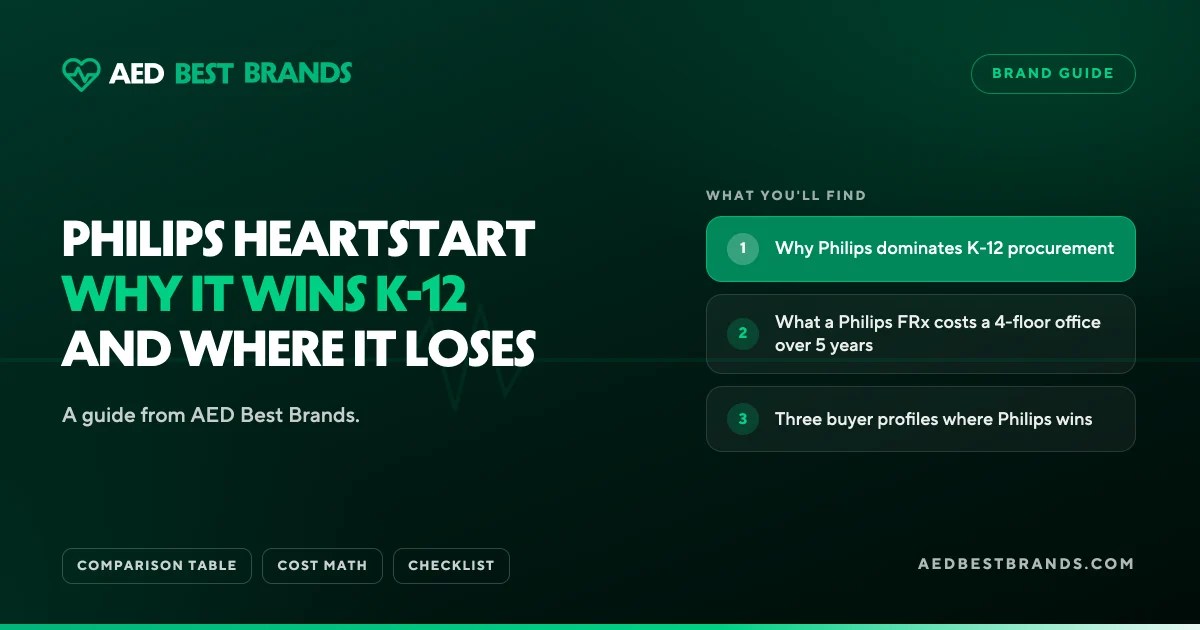
Philips HeartStart is the most common K-12 athletic procurement default across major state contracts, verified across the publicly disclosed approved vendor lists for California, Texas, Florida, and New York public schools (2023–2025). Most buyers assume this means Philips is the best K-12 AED. The data says Philips is the standardized K-12 AED, and those are not the same claim.
This review answers four questions a procurement officer, facility manager, or first-time buyer actually needs to answer before spending $1,500–$2,300: where Philips genuinely wins, where it loses to ZOLL, what the real 5-year math looks like, and which of the three current models (OnSite, FRx, FR3) fits which use case.
Decision shortcut Buy
Philips FRx if you run a K-12 school with athletic programs, a daycare, or any facility with non-medical staff who need the simplest interface and the Single Infant/Child Key pediatric mode. Buy Philips OnSite for indoor home or single-office deployment under $1,600. Skip Philips if you need real-time CPR depth feedback (ZOLL AED Plus), enterprise cellular fleet management (LIFEPAK CR2 Connected), or the lowest 5-year cost (HeartSine 350P).
Why Philips dominates K-12 procurement when it’s not always the best AED
The Philips HeartStart consumer line launched in 2002. The HeartStart OnSite launched in 2002 and is now FDA approved (PMA P160029); the FRx followed in 2005 and now holds PMA P180028. That ~22-year deployment history matters more than any current spec sheet because state K-12 procurement officers select from approved vendor lists, and approved vendor lists update slowly (typical state procurement cycle: 5–8 years between major vendor list refreshes).
California Education Code §35179.4 (AB 2009) mandated AEDs in athletic facilities effective 2020. State procurement officers chose Philips because Philips was already on every district’s emergency equipment vendor sheet from prior decade-plus deployments. The compliance deadline created urgency; the existing vendor relationship answered the urgency without requiring a new vendor approval cycle. See California AED Laws for the full compliance framework.
The result: Philips holds a dominant K-12 share through what Robert Greene would call “stored authority”, past visibility compounds into future selection. That’s a defensible market position, but it does not mean a 2026 buyer evaluating purely on spec should default to Philips. For schools updating procurement, see Best AED for Schools.
What does a Philips HeartStart FRx actually cost for a 4-floor office over 5 years?
The retail device price tells less than half the story. For a 4-floor, 120-person office deploying one FRx per floor, typical mid-size workplace configuration, the actual 5-year total cost compounds across four line items: device, battery, pads, and cabinet. Sourced calculation below.
4 × M5070A battery replacement @ year 4 ($249 each) = $996
4 × SMART Pads II replacement @ year 2 ($89 each) = $356
4 × SMART Pads II replacement @ year 4 ($89 each) = $356
4 × wall cabinet w/ alarm @ $189 = $756
4 × initial CPR + AED training (4 staff per floor × $35 AHA Heartsaver) = $560
4 × CPR re-cert at year 2 = $5605-year total: ~$11,980
Per-AED, per-year: ~$599
This excludes labor for monthly visual inspection (~$42/AED/year fully-loaded at $42/hr × 1 hr, facility manager rate within BLS 2024 occupation wage range of $35–50/hr fully-loaded) and rescue-event pad replacement. Run the AED Cost Calculator to verify against your configuration, the calculator pulls verified 2026 authorized distributor pricing. For multi-unit deployment, also run the AED Quantity Calculator.
Current US lineup, three models, three distinct buyers
| Model | FDA PMA | IP rating | Pediatric mode | Price (2026) | Verdict |
|---|---|---|---|---|---|
| HeartStart OnSite | PMA P160029 (2002) | IP21 (indoor) | Separate pediatric pads | ~$1,589 | Indoor home/office |
| HeartStart FRx | PMA P180028 | IP55 (jet water) | Single Infant/Child Key | $2,099 | K-12, daycares, sports |
| HeartStart FR3 | PMA P160028 | IP55 (jet water) | Pediatric cartridge | Quote-based | EMS/professional |
The OnSite vs FRx gap is ~$70 retail. Most buyers choose OnSite to save money and then discover IP21 isn’t acceptable for any outdoor or humid placement, see AED IP Ratings Explained. The FRx premium pays back in deployment flexibility for anyone considering eventual gym, pool deck, or outdoor athletic field placement.
Three buyer profiles where Philips wins
K-12 school administrator
Philips FRx is the path of least resistance K-12 procurement choice. State-approved vendor sheets reference Philips; existing district facilities likely already deploy Philips; CPR + AED training providers default to Philips device simulation. The pediatric Single Infant/Child Key is the operational closer, under the stress of a pediatric athletic incident, a teacher inserts one key rather than swapping pads. See Best AED for Schools.
Daycare/preschool operator
Daycare procurement officers face the same pediatric requirements as K-12, with no school nurse on site. The Single Infant/Child Key removes the decision point under stress. Many US daycares voluntarily deploy AEDs without a state mandate (estimated at several thousand based on state DOH disclosure data), Philips FRx is the typical pick. Full guidance: Best AED for Daycares.
HR director, non-medical staff workplace
Voice-prompt-only AEDs tend to perform well for untrained bystanders in published resuscitation simulation studies (a consistent finding across the literature, real-time depth feedback requires trained interpretation that untrained office staff often miss under stress). For an HR director deploying to a workforce without CPR certification, Philips’ simplicity wins. See Best AED for Offices.
The one buyer profile where ZOLL wins instead
Multi-location gym chains, healthcare facilities with CPR-trained staff, and any facility prioritizing CPR coaching during the rescue should pick ZOLL AED Plus over any Philips model. The accelerometer-based real-time depth and rate feedback addresses documented bystander CPR depth performance gaps, most untrained rescuers compress at well below AHA-recommended depth (5–6 cm / 2.0–2.4 in) per the 2020 Resuscitation Guidelines. ZOLL coaches the depth up in real time; Philips does not.
For these buyers, the $17 price difference between Philips FRx ($2,099) and ZOLL AED Plus ($2,082) is recovered through a reduced CPR effectiveness gap during the rescue. Full head-to-head: Philips FRx vs ZOLL AED Plus.
What Philips does not do, and what to buy instead
| If you need | Philips gap | Better choice |
|---|---|---|
| Real-time CPR depth + rate feedback | Voice prompts only | ZOLL AED Plus |
| Cellular fleet self-test reporting | No cellular option | LIFEPAK CR2 Connected |
| IP56 outdoor/marine rating | FRx max is IP55 | HeartSine 450P |
| Lowest 5-year total cost | ~$1,884 for FRx | HeartSine 350P (~$1,415) |
| 5-year battery + pad cycle | 4-year battery, 2-year pads | ZOLL AED Plus |
Decision checklist, is Philips right for you?
Buy Philips FRx if you can check at least 3
- The facility has non-medical staff (no nurse, no CPR-certified team on site)
- You need pediatric mode without pad-swap under stress (Single Infant/Child Key)
- Deployment includes K-12 athletic facility, daycare, or hospitality lobby
- Your state procurement list defaults to Philips (CA, TX, FL, NY public schools)
- You’re deploying 1–3 units, not a 10+ unit fleet
- Budget allows ~$1,884 5-year cost per unit (FRx + consumables + cabinet)
Skip Philips if you check any of these
- Staff is CPR-certified, and rescue depth feedback would meaningfully reduce time-to-effective-compression (go ZOLL)
- You’re managing 5+ AEDs across separate locations (go LIFEPAK CR2 Connected for cellular)
- Outdoor sustained-weather deployment is the primary use case (go HeartSine 450P at IP56)
- Lowest 5-year total cost is the priority (go HeartSine 350P)
Frequently asked questions
How much will a Philips HeartStart cost in 2026?
OnSite ~$1,589, FRx $2,099, FR3 Quote-based per 2026 authorized distributor reference pricing. Volume contracts typically reduce 8–12% on 5+ unit orders.
How long do Philips AED batteries last?
M5070A lithium primary battery: 4-year shelf life from activation per Philips Healthcare datasheet (2024 revision). Replacement cost $249.
How long do Philips AED pads last?
SMART Pads II (FRx) and SMART Pads (OnSite): 2-year shelf life from the manufacture date per Philips spec. Replacement ~$60.
Does Philips have a pediatric mode?
OnSite uses separate pediatric pads, requiring a full pad swap. FRx uses a Single Infant/Child Key that reconfigures the device for pediatric use without a pad swap, operationally meaningful under stress.
Is Philips OnSite weatherproof?
No. OnSite is IP21, drip-resistant only, for indoor use. For outdoor or humid placement, deploy FRx (IP55) or FR3 (IP55) with a weatherproof cabinet. See IP ratings explained.
Where do I buy a Philips AED?
Through authorized US distributors, AED Leader, Response Ready, or direct from Philips Healthcare. Gray-market resellers void warranties and miss FDA recall notifications.
Pediatric-first AED procurement
The free quiz routes daycare-profile buyers to the right pediatric-capable model.
Sources
- State of California Education Code §35179.4 (AB 2009)
- Philips Healthcare, HeartStart datasheet (2024 revision)
- FDA Premarket Approval (PMA) database, PMA P160029 (OnSite), P180028 (FRx), P160028 (FR3)
- AHA 2020 Resuscitation Guidelines, bystander CPR depth performance
- State DOE publicly disclosed approved vendor lists (CA, TX, FL, NY) 2023–2025
- BLS 2024 occupation wage data, facility manager fully-loaded rate range
Pricing reflects 2026 authorized distributor reference points. 5-year cost calculations exclude rescue-event consumables replacement. Specifications verified against current Philips Healthcare datasheets and the FDA PMA record.